

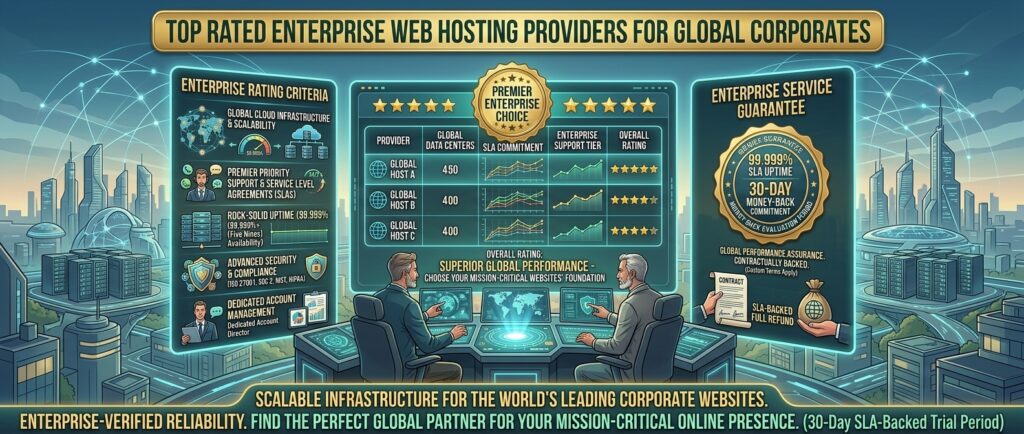
Best enterprise web hosting companies for large corporate websites. For large corporate enterprises, financial institutions, multi-national brand conglomerates, and high-volume media properties operating across major business centers like Texas, New York, California, Washington, and San Francisco, standard shared or entry-level virtual private hosting environments are entirely inadequate.
When your digital operations command millions of monthly visits, store sensitive proprietary consumer data, and require strict regulatory compliance (such as SOC 2, HIPAA, or PCI-DSS), a single minute of server downtime or a compromised security perimeter can result in devastating financial losses and catastrophic brand damage.
Corporate websites demand elite enterprise infrastructure engineered for absolute redundancy, high-availability multi-node clustering, uncompromised compute speed, and proactive 24/7 white-glove engineering support.
This comprehensive masterclass review guide analyzes the top-tier enterprise web hosting companies built specifically for large corporate websites, breaking down their hardware scalability, isolation models, compliance standards, and overall value.
What Defines True Enterprise Web Hosting?
Before exploring specific corporate hosting platforms, let’s examine the technical benchmarks that separate an enterprise-grade hosting provider from standard consumer hosting:
- High-Availability Redundancy & Load Balancing: Enterprise sites cannot rely on a single physical machine. True enterprise architecture utilizes multi-server clusters with automated failover and hardware load balancers. If one server node fails, traffic instantly reroutes to a secondary live node with zero downtime.
- Isolated Dedicated Resources: Corporate websites require dedicated hardware allocations—whether through dedicated physical servers or isolated cloud instances—guaranteeing that CPU threads, RAM, and storage arrays are never shared with external tenants.
- Proactive Managed Security and Compliance: Enterprise hosts provide advanced Web Application Firewalls (WAF), real-time behavioral intrusion detection, DDoS mitigation scrubbing centers, and compliance certifications essential for corporate data governance.
Top 5 Enterprise Web Hosting Companies for Large Corporate Websites
1. Liquid Web — The Premier Choice for Fully Managed Corporate Infrastructure
Liquid Web is widely recognized as an industry leader in managed enterprise hosting, powering mission-critical corporate websites, SaaS applications, and large-scale e-commerce stores.
- Enterprise Architecture: Offers fully customizable dedicated servers, high-performance clustered environments, and enterprise VMware private clouds.
- Performance & Speed: Built on high-clock-speed processors, enterprise NVMe storage arrays, and fully redundant network uplinks designed to absorb massive traffic spikes.
- Key Features: Proactive Sony-level hardware monitoring, custom firewall configurations, HIPAA and PCI-compliant hosting environments, and the legendary Heroic Support team available 24/7/365.
- Pros: Unmatched managed support for complex enterprise stacks; highly customizable hardware configurations; bulletproof reliability.
- Cons: Premium pricing structure tailored strictly for organizations with dedicated IT budgets.
2. ScalaHosting (Enterprise Cloud & Cluster Solutions) — Scalable Redundancy and Custom Management
ScalaHosting provides robust enterprise cloud clustering and dedicated server environments designed to give large corporate websites total structural flexibility without sacrificing administrative ease.
- Enterprise Architecture: Advanced cluster hosting featuring independent load balancers, database nodes, and file storage nodes configured for ultimate fault tolerance.
- Performance & Speed: Blazing-fast NVMe SSD storage pools, 10Gbps redundant network uplinks, and optimized server-level caching layers.
- Key Features: Proprietary SShield cybersecurity defense, fully managed migration services, dedicated IP allocations, and customized server hardening.
- Pros: Exceptional custom engineering support; scalable cluster architecture; strong cost-to-performance ratio for growing corporations.
- Cons: Highly customized cluster solutions require direct consultation with their sales and architecture teams.
3. AWS (Amazon Web Services) / Enterprise Cloud — Infinite Scalability for Global Giants
For major corporate entities requiring absolute control over custom cloud architecture, AWS stands as the global standard for cloud computing infrastructure.
- Enterprise Architecture: Decentralized multi-region cloud architecture utilizing EC2 compute instances, auto-scaling groups, Amazon RDS databases, and Elastic Load Balancing (ELB).
- Performance & Speed: Global edge infrastructure supported by Amazon CloudFront CDN, ensuring ultra-low latency delivery across domestic and international markets.
- Key Features: Granular access management (IAM), comprehensive compliance frameworks, automated container orchestration via Kubernetes (EKS), and endless scalability.
- Pros: Virtually limitless scalability; infinite configuration flexibility; industry gold standard for modern tech enterprises.
- Cons: Highly complex architecture requiring specialized cloud DevOps engineers to manage and maintain securely.
4. Google Cloud Platform (GCP) — Compute-Optimized Performance for Data-Heavy Enterprises
Google Cloud Platform powers some of the largest digital properties on earth, offering elite compute-optimized virtual machines and cutting-edge data analytics integrations.
- Enterprise Architecture: Compute-optimized (C2/C3D) instances, isolated container clusters, and multi-region database replication networks.
- Performance & Speed: Direct access to Google’s private global fiber-optic network, minimizing internet transit hops and accelerating page render speeds worldwide.
- Key Features: Advanced machine learning tools, enterprise security keys, native Cloudflare and enterprise CDN interconnections, and robust auditing logs.
- Pros: Incredible raw compute power; superior global network speed; excellent containerization tools.
- Cons: Complex billing models and administrative overhead demand experienced systems administrators.
5. Rackspace Technology — Multi-Cloud Managed Solutions for Global Corporations
Rackspace is a pioneer in managed cloud computing, specializing in comprehensive, end-to-end IT transformation and hosting management for Fortune 500 enterprises.
- Enterprise Architecture: Multi-cloud managed environments spanning private data centers, AWS, Microsoft Azure, and Google Cloud.
- Performance & Speed: Enterprise-grade network security shields, dedicated routing pathways, and customized load-balancing layers.
- Key Features: Fanatical support, enterprise migration specialists, 24/7 security operations center (SOC) monitoring, and disaster recovery planning.
- Pros: Comprehensive multi-cloud management; deep enterprise security expertise; tailored corporate SLAs.
- Cons: Enterprise contracts carry substantial minimum spending commitments and custom onboarding pricing.
Comparative Matrix: Enterprise Web Hosting Solutions
| Hosting Company / Platform | Primary Infrastructure Type | Management Tier | Key Security & Compliance Focus | Starting Price Tier |
| Liquid Web | Dedicated / VMware Private Cloud | Fully Managed | PCI / HIPAA / Proactive Monitoring | Enterprise Custom Quote |
| ScalaHosting | Cloud Clusters / VPS | Fully Managed | SShield AI / Isolated Nodes | Scaled Corporate Tiers |
| AWS | Decentralized Global Cloud (EC2) | Self-Managed / Co-Managed | Advanced IAM / Global Compliance | Pay-as-you-go Consumption |
| Google Cloud (GCP) | Compute-Optimized Instances | Self-Managed / Partner Managed | Enterprise Key Management / Logs | Pay-as-you-go Consumption |
| Rackspace | Multi-Cloud Managed Infrastructure | Fully Managed (Fanatical) | 24/7 SOC Monitoring / Custom SLAs | Enterprise Custom Quote |
Essential Best Practices for Corporate Web Hosting Migration & Architecture
Migrating or establishing a large corporate website requires meticulous planning to avoid catastrophic data loss or extended downtime. Follow these core architectural tips:
- Implement a Staging and Continuous Deployment (CI/CD) Pipeline: Never push code updates directly to a live corporate production server. Utilize dedicated staging environments and automated Git deployment workflows to test updates safely.
- Enforce Multi-Region Database Replication: For mission-critical corporate portals, ensure your primary database replicates in real-time across secondary data center regions (e.g., East Coast and West Coast failover zones) to protect against regional outages.
- Establish Rigorous Role-Based Access Control (RBAC): Restrict server root and administrative dashboard permissions strictly to authorized senior developers and DevOps personnel. Enforce mandatory multi-factor authentication (MFA) across all management portals.
- Conduct Regular Penetration Testing: Partner with external security auditing firms to simulate DDoS attacks, SQL injection attempts, and privilege escalation tests against your hosting perimeter on a quarterly basis.
Frequently Asked Questions (FAQ)
1. What makes enterprise web hosting different from standard business hosting?
Enterprise hosting provides dedicated or isolated hardware clusters, guaranteed SLAs with 99.99%+ uptime, multi-node redundancy, and 24/7 direct access to senior systems engineers.
2. When should a company upgrade from standard VPS to enterprise hosting?
You should upgrade when your site experiences high concurrent traffic volumes that risk crashing standard servers, when you handle sensitive financial or healthcare data requiring regulatory compliance, or when downtime directly threatens core revenue streams.
3. What is a Service Level Agreement (SLA) in enterprise hosting?
An SLA is a legally binding contract guaranteeing specific performance metrics—most notably 99.99% or 100% uptime—with financial compensation or service credits provided to the client if the host fails to meet those benchmarks.
4. Is managed enterprise hosting better than self-managed cloud (like raw AWS)?
Managed enterprise hosting (such as Liquid Web or ScalaHosting) provides an expert engineering team to handle server updates, security patches, and troubleshooting, whereas raw cloud providers (like AWS or GCP) require you to employ your own DevOps staff.
5. How do enterprise hosts handle massive traffic surges?
Enterprise hosts utilize load balancers to distribute incoming user traffic across multiple server nodes, alongside auto-scaling groups that dynamically provision extra CPU and RAM resources during peak demand.
6. What compliance standards should my corporate web host support?
Depending on your industry, your host should support PCI-DSS (for e-commerce/credit cards), HIPAA (for healthcare data), SOC 2 Type II (for security controls), and GDPR/CCPA data privacy regulations.
7. Can enterprise hosting prevent DDoS attacks?
Yes. Enterprise hosting packages include robust, multi-terabit perimeter scrubbing networks and automated Web Application Firewalls (WAF) that neutralize malicious volumetric and application-layer floods.
8. How long does a corporate website migration take?
Migrating a large, complex corporate website with extensive databases and media assets can take anywhere from several days to a few weeks, depending on planning, DNS propagation windows, and data volume.
9. What is high-availability (HA) clustering?
High-availability clustering links multiple independent servers together so that if one node experiences a hardware failure, operational workloads seamlessly transfer to a backup node without service interruption.
10. Which enterprise web host is the best overall recommendation?
For comprehensive, fully managed corporate infrastructure backed by legendary support, Liquid Web is the top overall recommendation for businesses seeking turnkey reliability—while AWS and Google Cloud lead for custom-built, developer-driven enterprise architectures.
Conclusion
Securing the digital infrastructure of a large corporate website is a foundational decision that impacts brand reputation, security compliance, and long-term revenue growth. By partnering with an elite enterprise web hosting provider—such as Liquid Web, ScalaHosting, AWS, Google Cloud, or Rackspace—corporations, financial institutions, and digital enterprises operating across high-competition economic powerhouses like Texas, New York, California, Washington, and San Francisco can achieve uncompromised speed, absolute data security, and infinite operational scalability.