

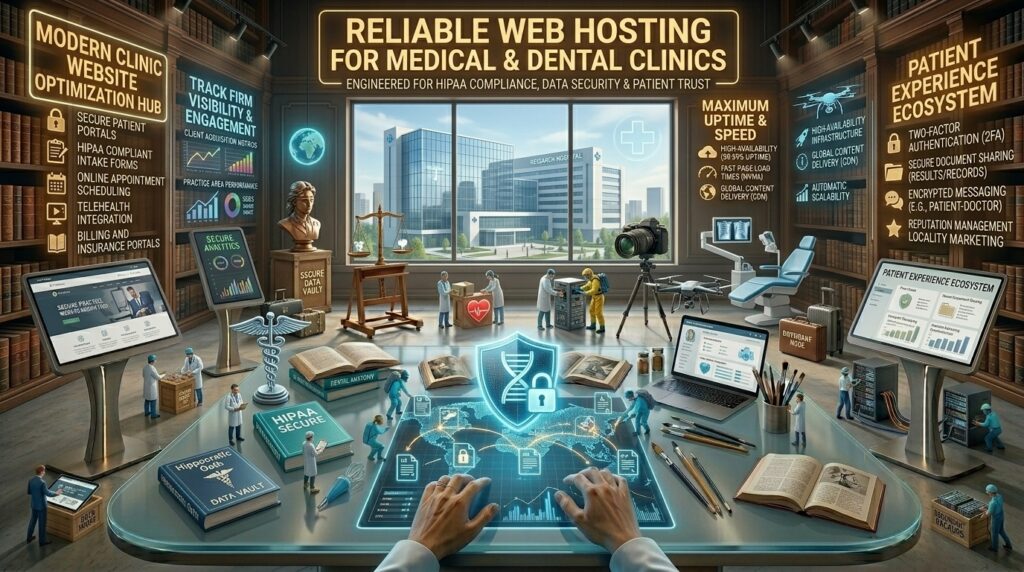
What is the reliable web hosting for medical and dental clinics? For medical practices, dental clinics, specialty care centers, and healthcare groups operating across major competitive markets like Texas, New York, California, Washington, and San Francisco, your website is often a patient’s very first point of contact. Long before a patient calls to schedule a checkup, book an orthodontic consultation, or look up clinic operating hours, they evaluate your practice online.
In the healthcare sector, a website functions as a vital patient care tool. It handles appointment booking requests, contact messages, secure intake forms, and confidential patient inquiries. Because of this sensitive operational weight, choosing the right web hosting infrastructure is paramount. A slow, unstable, or poorly secured web host risks patient trust, triggers compliance failures, and severely damages your local search rankings.
This comprehensive guide breaks down the essential hosting requirements for medical and dental clinics, reviews the top-performing platforms on the market, and provides an expert technical roadmap to dominate local Google search results.
1. Why Healthcare Websites Demand Specialized Hosting Infrastructure
Many medical and dental practices make the mistake of using generic, cheap shared hosting plans, assuming a simple practice website requires minimal server power. However, healthcare websites carry unique technical, regulatory, and performance demands:
- Patient Data Security and Regulatory Compliance: If your website collects, processes, or stores electronic Protected Health Information (ePHI)—such as online patient intake forms, symptom checkers, or client portal logins—your infrastructure must comply with the Health Insurance Portability and Accountability Act (HIPAA). This requires encrypted databases, secure transmission layers, and a signed Business Associate Agreement (BAA) from your web host.
- Local SEO and Core Web Vitals: Google’s search algorithms reward local medical and dental practices that offer fast, frictionless mobile experiences. If your site’s Time to First Byte (TTFB) is slow due to underpowered hosting, prospective patients will bounce to a competing clinic, directly hurting your local map pack rankings.
- Flawless Uptime for Urgent Care Inquiries: Patients seeking emergency dental care or immediate medical guidance expect websites to load instantly 24/7. Frequent server outages mean lost appointment leads and frustrated prospective patients.
- Protection Against Malicious Cyber Threats: Healthcare websites are prime targets for automated botnets, SQL injections, and ransomware vectors. Enterprise-grade web hosting shields your database from malicious actors.
2. Essential Technical and Compliance Features to Demand
Before choosing a web hosting provider for your clinic, verify that the platform meets these rigorous medical-grade benchmarks:
- Signed Business Associate Agreement (BAA): If your site handles any form of PHI or patient data intake, your host must be willing to sign a BAA legally binding them to HIPAA security standards.
- End-to-End Encryption (SSL/TLS) & Secure Databases: All traffic must run over forced HTTPS using robust TLS configurations, with database storage encrypted at rest using AES-256 standards.
- Isolated Account Architecture: Avoid multi-tenant shared hosting where hundreds of unrelated websites sit on the same server partition. Opt for isolated cloud instances, VPS, or managed enterprise WordPress environments.
- Automated Daily Off-Site Backups: Medical and patient scheduling databases must be backed up daily to secure, isolated external servers with one-click restoration options.
3. Top Web Hosting Providers Ranked for Medical and Dental Practices
Based on security infrastructure, HIPAA readiness, speed performance, and reliability, here are the top hosting options for healthcare providers:
A. HIPAA Vault (Best Specialized HIPAA-Compliant Managed Hosting)
HIPAA Vault is an industry leader specializing entirely in managed, cloud-based hosting solutions engineered specifically for the healthcare sector.
- Why it shines for Clinics: They sign a BAA for every client, provide fully managed security configurations, employ rigorous Web Application Firewalls (WAF), and house data in strictly audited, secure data centers.
- Best For: Medical groups, dental clinics, and healthcare portals handling active patient data and ePHI.
- Pricing: Custom enterprise and managed cloud pricing tailored to practice scale.
B. Liquid Web (Best High-Performance Managed Hosting with BAA Options)
Liquid Web is globally renowned for enterprise-grade performance, mission-critical reliability, and robust managed infrastructure.
- Why it shines for Clinics: Liquid Web offers specialized HIPAA-compliant hosting environments backed by third-party audits, advanced server-side controls, and data encryption at rest, alongside a willingness to sign a BAA.
- Best For: Multi-doctor practices, dental chains, and growing medical clinics wanting enterprise performance with white-glove support.
- Pricing: Plans typically start around $20 to $150+/month depending on the managed infrastructure tier.
C. WP Engine (Best Managed WordPress Hosting for Informational Clinic Sites)
For medical and dental practices utilizing WordPress strictly for informational purposes, service listings, provider bios, and non-PHI appointment booking plugins, WP Engine is exceptional. (Note: Standard WordPress hosts do not sign BAAs unless paired with specialized third-party secure forms).
- Why it shines for Clinics: Exceptional speed, proactive vulnerability scanning, isolated architecture, and lightning-fast TTFB scores that boost local SEO performance.
- Best For: Practice websites focused on branding, educational blogs, local SEO, and standard contact forms.
- Pricing: Plans start around $20 to $115+/month.
D. SiteGround (Best Balanced Managed Host for Boutique Practices)
SiteGround provides robust Google Cloud-powered hosting paired with advanced security monitoring and anti-bot systems.
- Why it shines for Clinics: Features automated daily backups, free SSL certificates, a built-in web application firewall, and fast response times ideal for local medical SEO.
- Best For: Solo dental practitioners and local clinics looking for reliable performance on a moderate budget.
- Pricing: Introductory plans start around $2.99 to $7.99/month.
4. Masterclass: Maximizing Local SEO for Medical and Dental Clinics
Having a secure, fast website is essential, but you also need patients to find you. Implement these advanced local SEO strategies to dominate Google search results in your target city:
Optimizing for “Near Me” and Local Search Intent
Patients searching for care use hyper-local intent (e.g., “Emergency dentist in San Francisco” or “Pediatrician in Dallas, TX”). Structure your website directory cleanly to target your specific geographical service areas (e.g., [yourclinic.com/locations/new-york/manhattan](https://yourclinic.com/locations/new-york/manhattan)) and embed verified Google Business Profile maps using lightweight loading methods that do not hurt your server speed.
Healthcare Schema Markup (MedicalClinic & Dentist)
Incorporate precise MedicalClinic, Dentist, or Physician schema markup across your site’s header code. This structured data enables Google to display rich snippets, operating hours, review ratings, and direct booking links in search results, maximizing your local click-through rate.
Passing Core Web Vitals for Mobile Patients
Over 70% of patients searching for medical care do so from mobile smartphones. Google evaluates your site using mobile-first indexing and Core Web Vitals (Largest Contentful Paint and Interaction to Next Paint). Ensure your host maintains a rapid server response time so patients can quickly access your phone number, address, and booking forms.
5. Frequently Asked Questions (FAQ)
1. Does my medical or dental clinic website legally require HIPAA-compliant hosting?
If your website simply serves as an informational brochure displaying your office hours, address, team bios, and standard non-encrypted contact info, HIPAA hosting is not strictly mandatory. However, if your site features patient portals, online intake forms, health questionnaires, or chat widgets that collect ePHI, HIPAA-compliant hosting and a signed BAA are legally required.
2. What is a BAA (Business Associate Agreement), and why do I need it?
A Business Associate Agreement is a legal contract between your medical practice and your web hosting provider. It guarantees that the host takes full legal responsibility for safeguarding electronic Protected Health Information (ePHI) in accordance with federal HIPAA guidelines.
3. Can I use cheap $3/month shared hosting for my dental clinic website?
Using cheap shared hosting for a healthcare practice is strongly discouraged. Shared servers lack proper isolation, meaning a security breach on a neighboring website can compromise your entire server, risking patient data leaks and severe regulatory fines.
4. How does website speed affect my clinic’s patient acquisition?
Prospective patients seeking healthcare are often impatient or stressed. If your website takes more than 3 seconds to load, visitors will bounce to a competitor. Furthermore, Google penalizes slow websites in local search rankings.
5. Are standard free SSL certificates enough to protect my clinic’s website?
A standard SSL certificate encrypts data in transit between the patient’s browser and your server (enabling HTTPS). While mandatory, it does not cover server-side encryption at rest, secure data centers, or HIPAA-compliant access controls.
6. How often should my clinic’s website and patient database be backed up?
Your hosting provider must execute automated daily backups stored securely on independent off-site servers. This ensures that your appointment logs and site files can be restored instantly following any technical glitch.
7. What is the difference between managed and unmanaged healthcare hosting?
Managed hosting means the provider handles server updates, security patches, firewall configurations, and system monitoring for you. Unmanaged hosting requires your internal team or IT agency to manually handle all security hardening and server administration.
8. How can I securely manage online appointment bookings without violating HIPAA?
Instead of building unencrypted custom databases on your web server, integrate your site with trusted, HIPAA-compliant third-party scheduling platforms (such as specialized medical booking widgets) that securely handle patient scheduling data.
9. Will switching my clinic to a faster web host improve my Google map rankings?
Yes. Improving your server response times (TTFB) and Core Web Vitals directly enhances mobile user experience, which is a key weighting factor in Google’s local map pack algorithm.
10. How can I test if my current clinic website is secure and fast?
You can run your clinic’s URL through trusted evaluation tools like Google PageSpeed Insights (for speed and Core Web Vitals) and Qualys SSL Labs or Sucuri SiteCheck (for security and SSL configuration audits).
6. Conclusion
Selecting the right web hosting provider is a critical operational decision for medical and dental practices. Relying on generic, insecure hosting exposes your practice to data vulnerabilities, sluggish performance, and lost patient appointments.