

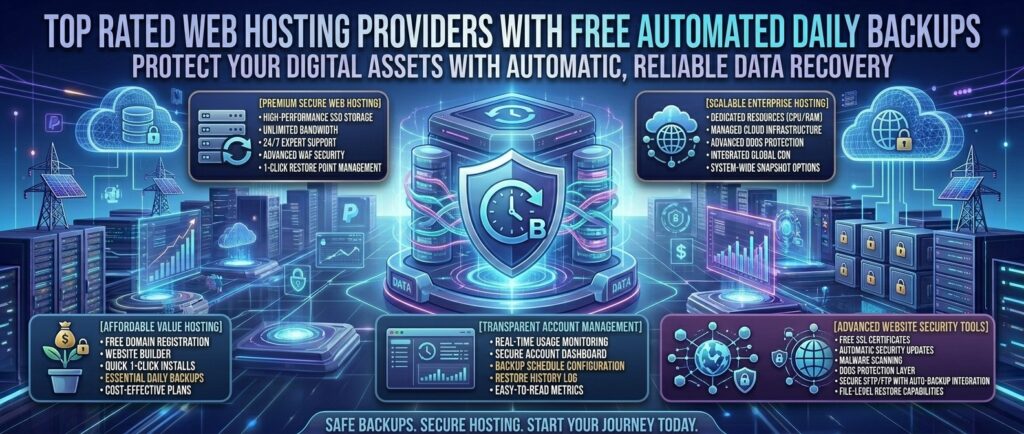
Top rated web hosting providers with free automated daily backups. For digital entrepreneurs, e-commerce store operators, and web agency directors building and scaling web properties across competitive metropolitan powerhouses like Texas, New York, California, Washington, and San Francisco, data loss is the ultimate existential threat.
Whether it is a corrupted plugin update, an accidental database deletion by a staff member, or a sophisticated malicious cyber-attack, a single fatal error can wipe out months of hard work, compromise customer transactions, and ruin your search engine rankings overnight.
Relying on manual backups—where you remember to export your SQL database once a month or download a zipped file onto your local desktop—is a high-risk gamble.
The industry standard for professional business continuity is a free automated daily backup system.
The top-tier hosting providers handle your disaster recovery infrastructure natively, capturing clean snapshots of your entire website files, folders, email configurations, and databases every 24 hours without impacting server performance.
This exhaustive masterclass review guide analyzes the top-rated web hosting providers featuring free automated daily backups, comparing their snapshot retention windows, restoration workflows, security frameworks, and overall value.
Why Free Automated Daily Backups Are Non-Negotiable
Before evaluating specific hosting architectures, let’s examine why built-in daily backups are critical for professional web operations:
- Instant Disaster Recovery: If a bad code update crashes your site, an automated daily backup allows you to restore your production environment to a fully functional state with a single click.
- Mitigating Third-Party Plugin Failures: Free or cheap backup plugins often crash mid-process on large websites due to PHP memory limits or timeout errors. Server-level automated backups operate independently of your CMS.
- Protection Against Ransomware & Malicious Hacks: If malicious scripts inject spam or alter core system files, having clean historical restore points ensures you can wipe and recover your site cleanly.
Top 5 Web Hosting Providers with Free Automated Daily Backups
1. SiteGround — The Gold Standard for Automated Backup & Security
SiteGround is universally recognized as a premier managed hosting platform, beloved by digital agencies and professional publishers who prioritize high reliability and data protection.
- Backup Implementation: SiteGround includes free automated daily backups on all of its hosting plans (including the entry-level StartUp tier). Their system captures a snapshot every 24 hours and stores up to 30 custom backup copies on isolated backup servers.
- Restoration Workflow: Their custom Site Tools dashboard features an ultra-intuitive recovery wizard. You can restore your entire account, specific files only, or just the MySQL database with a single click. You can also generate on-demand manual backup copies before testing risky updates.
- Infrastructure & Speed: Built on Google Cloud infrastructure with custom dynamic caching and an advanced in-house Web Application Firewall (WAF).
- Pros: Generous 30-day archive window; highly intuitive 1-click restoration tools; elite security protocols.
- Cons: Higher renewal rates after the initial introductory promotional term expires.
2. Hostinger — Best Value Provider with Automated Backups
Hostinger has rapidly grown into one of the world’s most popular web hosts by combining high-performance LiteSpeed server hardware with aggressive pricing.
- Backup Implementation: Hostinger provides free automated daily backups (alongside weekly backups) on all standard business and cloud hosting tiers, ensuring your critical web assets are continuously archived.
- Restoration Workflow: Inside the custom
hPaneldashboard, users can access the “Files > Backups” menu, view a calendar history of available daily snapshots, and restore files or databases instantly without contacting support. - Infrastructure & Speed: Powered by LiteSpeed web servers, built-in object caching, and global data center routing.
- Pros: Outstanding pricing for beginners; blazingly fast page load speeds; simple backup file download options.
- Cons: Basic entry-level shared plans may rely on weekly rather than daily backups, requiring an upgrade to premium tiers.
3. GreenGeeks — Eco-Friendly Hosting with Comprehensive Nightly Backups
GreenGeeks combines 300% green renewable energy matching with high-speed cloud infrastructure, making it a favorite for eco-conscious web creators and small businesses.
- Backup Implementation: GreenGeeks includes free automated real-time nightly backups across all of its standard web hosting plans, ensuring data is captured and secured every single day.
- Restoration Workflow: Accessible directly via the account management console or standard control panel integrations, allowing users to restore database tables or directories swiftly.
- Infrastructure & Speed: Containerized cloud architecture utilizing solid-state NVMe drives and LSCache acceleration.
- Pros: 300% green energy match; dependable nightly backups included out of the box; robust customer support.
- Cons: Promotional pricing requires an annual commitment to secure the lowest monthly rate.
4. ScalaHosting — Advanced Cloud VPS with Off-Site Automated Backups
ScalaHosting is famous for its proprietary SPanel control management system and high-performance managed cloud setups designed for e-commerce sites and growing agencies.
- Backup Implementation: Features automated off-site daily backups stored on remote disaster recovery servers separate from your primary node, guaranteeing data integrity even during hardware failures.
- Restoration Workflow: Through
SPanel, users can manage snapshots, select specific restore points, and deploy point-in-time recovery configurations seamlessly. - Infrastructure & Speed: 100% NVMe solid-state storage arrays with dedicated CPU/RAM allocations and real-time SShield cybersecurity monitoring.
- Pros: True remote off-site backup isolation; exceptional scaling capacity for online stores.
- Cons: Advanced cloud VPS plans have a steeper learning curve for absolute beginners compared to basic shared options.
5. DreamHost — Veteran Host with Flexible Backup Options
DreamHost is a legacy independent hosting provider officially recommended by WordPress.org, offering rock-solid stability and transparent operational policies.
- Backup Implementation: DreamHost generates automated daily snapshots of website databases and user directories, storing them natively for quick recovery.
- Restoration Workflow: Users can manage backups via the custom DreamHost control panel, download individual backup archives, or restore files back to production instantly.
- Infrastructure & Speed: Custom control panels, fast SSD storage infrastructure, and free privacy protection included with domain registrations.
- Pros: Industry-leading 97-day money-back guarantee; transparent pricing model with no hidden catches.
- Cons: Live chat support availability can occasionally experience queue delays during peak international hours.
Comparative Matrix: Backup-Equipped Hosting Providers
| Hosting Provider | Backup Frequency | Backup Retention Window | Off-Site Storage? | Starting Price |
| SiteGround | Daily | 30 Days | Yes | $3.95 / mo |
| Hostinger | Daily | Up to 30 Days | Yes | $2.99 / mo |
| GreenGeeks | Nightly | Daily Snapshots | Yes | $2.95 / mo |
| ScalaHosting | Daily | Multiple Restore Points | Yes (Remote) | $12.95 / mo |
| DreamHost | Daily | Recent Snapshots | Yes | $2.59 / mo |
Best Practices for Managing Website Backups
Even with automated server-level backups running smoothly in the background, professional webmasters adhere to the 3-2-1 Backup Rule to guarantee absolute disaster resilience:
- Maintain 3 Total Copies of Your Data: Your live production site, your host’s automated daily server backup, and an independent local copy.
- Utilize 2 Different Storage Mediums: Keep your primary server files backed up both on your host’s cloud array and downloaded periodically to an external hard drive or secure cloud storage locker (like Google Drive or Dropbox).
- Keep 1 Off-Site Archive: Ensure your backups are stored on a separate physical server facility from your live hosting node—a standard feature provided by top-tier hosts like ScalaHosting and SiteGround.
- Test Your Restores Periodically: A backup is only as good as its restoration process. Once a quarter, deploy your backup to a staging environment to verify that database tables and media assets unpack correctly.
Frequently Asked Questions (FAQ)
1. What is an automated daily backup?
An automated daily backup is a system set up by your web hosting provider that automatically creates a complete snapshot (files, databases, emails) of your website every 24 hours without requiring manual input.
2. Are automated daily backups always free?
No. While premium hosts like SiteGround and GreenGeeks include daily backups for free in their core plans, budget hosts often charge extra for daily backup add-ons or limit you to basic weekly snapshots.
3. What is the difference between daily backups and staging environments?
A backup is a saved recovery snapshot used to restore your site after a crash. A staging environment is a live testing clone used to try out updates safely before pushing them to production.
4. How long do hosting providers keep daily backups?
Retention windows vary by provider. SiteGround stores daily backups for up to 30 days, whereas standard budget hosts may only keep backups for the last 7 days or overwrite them after 24 hours.
5. Can I download my server backups to my local computer?
Yes. Top hosts allow you to download .tar.gz archive files or SQL database dumps directly to your desktop via their control panel or an FTP client.
6. Do automated backups slow down my live website?
No. Reputable hosts run automated backups during off-peak traffic hours (typically late at night) using isolated server background threads to prevent any impact on your live site speed.
7. What should I do before updating plugins if I have daily backups?
Even with automated backups, it is always a smart practice to click “Generate Manual Backup” right inside your host’s dashboard immediately before running major WordPress core or e-commerce plugin updates.
8. Will restoring a backup overwrite my recent e-commerce orders?
If you restore a backup from 3 days ago, any new e-commerce orders or user registrations placed in the last 3 days will be lost unless you perform a selective database restore or back up recent order tables separately.
9. Are automated backups enough protection against hackers?
Backups protect you from data loss if a hack occurs, but you should still use robust security layers (like web application firewalls and strong passwords) to prevent intrusions in the first place.
10. Which hosting provider offers the best backup system overall?
For seamless 1-click restorations, a 30-day archive window, and bulletproof reliability, SiteGround is the top overall industry recommendation.
Conclusion
Operating a digital property without automated daily backups is an unnecessary risk. By choosing a top-rated web hosting provider equipped with robust, free automated daily snapshot technology—such as SiteGround, Hostinger, GreenGeeks, ScalaHosting, or DreamHost—web creators, developers, and enterprises across major business hubs like Texas, New York, California, Washington, and San Francisco can scale their online operations with total confidence, knowing their data is fully protected against any unexpected emergency.