

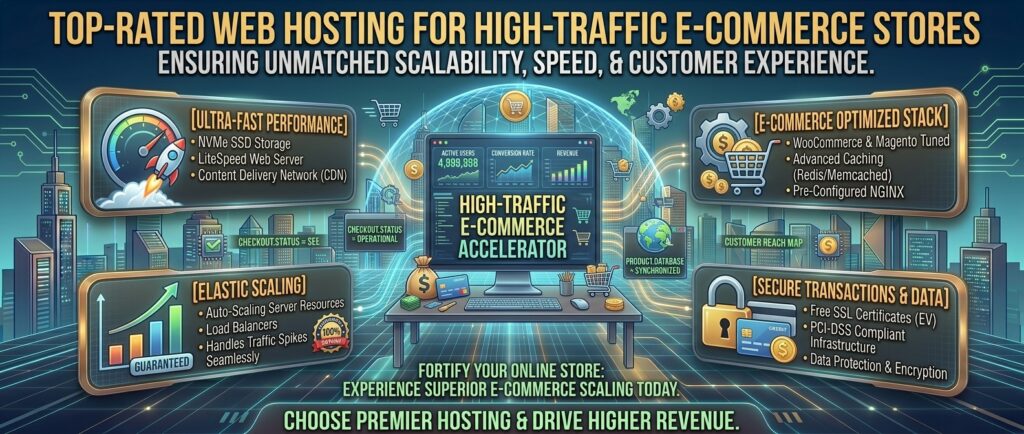
Top rated web hosting providers for high traffic e-commerce stores. For online store owners, direct-to-consumer (DTC) brands, and digital retail enterprises managing web properties across major competitive markets like Texas, New York, California, Washington, and San Francisco, ordinary web hosting is a recipe for commercial disaster.
When your online store experiences a sudden surge of traffic—whether triggered by a viral social media campaign, a seasonal holiday rush like Black Friday, or a regional marketing blitz—every millisecond of delay directly translates to abandoned shopping carts and lost revenue.
In the world of high-volume digital commerce, standard shared hosting servers quickly buckle under the weight of dynamic database transactions, inventory queries, and concurrent user sessions. High-traffic e-commerce stores demand robust server infrastructure engineered explicitly for speed, scalability, and absolute security compliance.
This masterclass review guide analyzes the top-rated web hosting providers built specifically for high-traffic e-commerce stores, comparing their performance architectures, caching layers, server specifications, and overall value.
Why High-Traffic E-Commerce Stores Require Specialized Hosting
Before reviewing specific hosting platforms, let’s examine why traditional web hosting fails under heavy retail traffic and what technical requirements are mandatory for success:
- Dynamic Database Queries vs. Static Caching: Unlike a standard static blog, e-commerce sites rely heavily on dynamic user sessions, shopping carts, checkout forms, and real-time inventory updates. Standard page caching breaks checkout workflows, making advanced object caching (Redis or Memcached) mandatory.
- Handling PHP Workers and Concurrent Load: Every time a user adds an item to their cart, your server spins up a PHP worker process. If your host caps your PHP workers too low, simultaneous visitors will encounter fatal 503 Service Unavailable errors during peak traffic spikes.
- PCI-DSS Compliance and Security: E-commerce stores handle sensitive customer financial details. Your host must provide enterprise-grade web application firewalls (WAF), automated malware isolation, and secure SSL environments.
Top 5 Web Hosting Providers for High-Traffic E-Commerce Stores
1. SiteGround — The Gold Standard for Managed WooCommerce Performance
SiteGround is widely celebrated as one of the premier hosting environments for WordPress and WooCommerce-powered online stores, backed by custom-engineered speed optimization tools.
- E-Commerce Architecture: SiteGround runs on Google Cloud infrastructure featuring custom dynamic caching, isolated account resource management, and automated staging environments for safe plugin updates.
- Performance & Speed: Integrates an in-house SG Optimizer plugin, multi-region CDN routing, and Ultrafast PHP execution handlers to keep transaction speeds lightning fast.
- Key Features: Automated daily backups, free website migrations, robust staging toolkits, and legendary 24/7 technical support from WordPress experts.
- Pros: Exceptional reliability; unmatched customer support for e-commerce troubleshooting; scalable cloud options.
- Cons: Higher renewal rates after the initial introductory promotional term concludes.
2. Nexcess (by Liquid Web) — Fully Managed Enterprise E-Commerce Powerhouse
Nexcess specializes in fully managed cloud hosting optimized for high-volume WooCommerce, Magento (Adobe Commerce), and expression engine stores that demand uncompromised performance.
- E-Commerce Architecture: Built-in Enterprise Level Object Caching (Redis) and automated database query optimization ensure heavy product catalogs load instantly, even under massive traffic loads.
- Performance & Speed: Includes built-in image compression, automated visual regression testing for safe updates, and a high-performance global CDN network.
- Key Features: Auto-scaling technology that temporarily provisions extra server resources during unexpected traffic spikes without crashing your checkout process.
- Pros: Zero overage penalty worries; expert e-commerce engineers on standby 24/7; auto-scaling built into core plans.
- Cons: Premium pricing structure reflects its high-end enterprise positioning.
3. Hostinger (Cloud Global Plans) — High-Performance LiteSpeed Infrastructure for Scale
Hostinger has transformed the high-performance hosting sector by coupling ultra-fast LiteSpeed server architecture with enterprise-grade cloud node scaling.
- E-Commerce Architecture: Deploys 100% LiteSpeed Web Server technology integrated with native LSCache and object caching layers, capable of handling tens of thousands of concurrent store visitors smoothly.
- Performance & Speed: Powered by NVMe solid-state storage arrays, global CDN edge routing, and dedicated IP allocations.
- Key Features: Automated daily backups, integrated e-commerce security suites, email hosting, and an intuitive custom management dashboard.
- Pros: Incredible price-to-performance ratio; lightning-fast TTFB metrics; reliable cloud resource scaling.
- Cons: High-end cloud tiers are required for massive multi-warehouse stores.
4. WP Engine — Premium Managed WordPress & WooCommerce Hosting
WP Engine is an industry leader in managed WordPress and WooCommerce enterprise hosting, powering some of the largest digital storefronts on the web.
- E-Commerce Architecture: Features proprietary EverCache technology—a scalable caching architecture built specifically to handle complex database queries and high-volume e-commerce traffic without sweating.
- Performance & Speed: Integrated Global Edge Security, automated threat blocking, and high-speed content delivery networks optimized for retail conversions.
- Key Features: Automated plugin update testing, staging environments, advanced developer toolkits, and proactive security monitoring.
- Pros: Bulletproof security; optimized for high-volume sales conversions; exceptional developer support.
- Cons: Strict plugin restrictions and visitor caps can lead to extra fees if traffic thresholds are exceeded.
5. Shopify — The Ultimate All-in-One Hosted E-Commerce Platform
For merchants who prefer a dedicated, fully hosted SaaS e-commerce ecosystem rather than managing a self-hosted CMS like WooCommerce, Shopify is the gold standard.
- E-Commerce Architecture: A fully managed, multi-tenant cloud infrastructure engineered to handle massive Black Friday traffic spikes with 99.99% uptime and zero server maintenance overhead.
- Performance & Speed: Global edge CDN caching, lightning-fast product image delivery, and optimized one-click checkout funnels (Shop Pay).
- Key Features: Advanced inventory management tools, integrated multi-channel selling, automated tax calculation engines, and secure PCI Level 1 compliance out of the box.
- Pros: Completely hands-off infrastructure management; massive app store ecosystem; industry-leading conversion funnels.
- Cons: Monthly subscription costs plus transaction fee structures unless utilizing Shopify Payments.
Comparative Matrix: E-Commerce Hosting Providers
| Hosting Provider | Primary Platform Focus | Caching Mechanism | Scalability Type | Starting Price |
| SiteGround | WordPress / WooCommerce | Dynamic + SG Optimizer | Cloud / Vertical | $3.99 / mo |
| Nexcess | WooCommerce / Magento | Redis Object Caching | Auto-Scaling Cloud | $19.00 / mo |
| Hostinger | Multi-CMS / Cloud | LSCache + LiteSpeed | Cloud Resource Tiers | $8.99 / mo |
| WP Engine | Managed WordPress | EverCache Architecture | Tiered Traffic Plans | $20.00 / mo |
| Shopify | Dedicated E-Commerce SaaS | Global Edge CDN | Fully Managed Cloud | $29.00 / mo |
Essential Best Practices to Optimize a High-Traffic E-Commerce Store
Choosing a high-performance host is only half the battle. To guarantee your store withstands major traffic spikes without crashing, apply these professional optimization tips:
- Implement Redis or Memcached Object Caching: Ensure your e-commerce database isn’t bogged down by repetitive product attribute queries. Server-level object caching stores database query results in RAM for instant retrieval.
- Optimize and Compress Product Photography: High-resolution product images are the number one cause of slow load times. Convert images to modern WebP formats and lazy-load gallery items below the fold.
- Exclude Cart and Checkout Pages from Page Caching: Never cache dynamic user sessions like
/cart,/checkout, or/my-account. Configure cache exclusion rules so customers always see their correct live cart contents. - Perform Load Testing Before Major Sales Events: Use testing tools (like k6 or Loader.io) to simulate thousands of simultaneous shoppers hitting your checkout page, allowing you to identify bottlenecks before your actual marketing launch.
Frequently Asked Questions (FAQ)
1. Why is standard shared hosting bad for high-traffic e-commerce stores?
Standard shared hosting pools resources across hundreds of sites. Sudden traffic spikes on your store or a neighboring site will exhaust your CPU and PHP worker allocations, causing server timeouts and lost sales.
2. What is a PHP worker, and why does it matter for e-commerce?
A PHP worker is a background process that executes dynamic code to load pages, add items to carts, and process checkouts. High-traffic stores need a high count of concurrent PHP workers to prevent slow checkout speeds.
3. What is the difference between page caching and object caching?
Page caching stores fully rendered HTML pages for fast delivery, while object caching stores database query results in server memory, which is vital for dynamic e-commerce features like inventory counts and user carts.
4. Do I need PCI-DSS compliance for my online store?
Yes. If your store accepts credit card payments, your hosting environment must meet Payment Card Industry Data Security Standards (PCI-DSS) to protect consumer financial data.
5. How does auto-scaling protect my store during a traffic surge?
Auto-scaling automatically provisions extra CPU and RAM resources to your server instance during unexpected traffic spikes, preventing your store from crashing when it goes viral.
6. Is WooCommerce better than Shopify for high-traffic stores?
WooCommerce offers total code ownership and deep customization flexibility, while Shopify provides a fully managed, hands-off infrastructure where server maintenance is handled entirely by the platform.
7. Can I migrate my existing e-commerce store to a new host for free?
Yes. Reputable e-commerce hosts (such as SiteGround and Nexcess) include professional white-glove website migration services handled by their technical support teams at no extra charge.
8. Will a Content Delivery Network (CDN) improve my store’s loading speed?
Yes. A CDN caches static assets (images, CSS, JavaScript) across global edge servers, delivering files from a data center physically closest to your shoppers.
9. What should I do if my e-commerce site experiences a 503 Service Unavailable error?
A 503 error usually indicates that your server has run out of PHP workers or hit its memory limit due to high traffic. Upgrading your plan or optimizing database queries resolves the bottleneck.
10. Which e-commerce web host is the best overall recommendation?
For a reliable balance of stellar customer support, robust WooCommerce optimization, and scalable cloud performance, SiteGround and Nexcess are the top industry recommendations.
Conclusion
Maximizing conversions and protecting revenue on a high-traffic e-commerce store requires elite server infrastructure. By partnering with a specialized high-performance web host—such as SiteGround, Nexcess, Hostinger, WP Engine, or Shopify—retailers, entrepreneurs, and digital brands operating across major commercial centers like Texas, New York, California, Washington, and San Francisco can guarantee lightning-fast checkout speeds, bulletproof security compliance, and absolute resilience during peak traffic surges.