

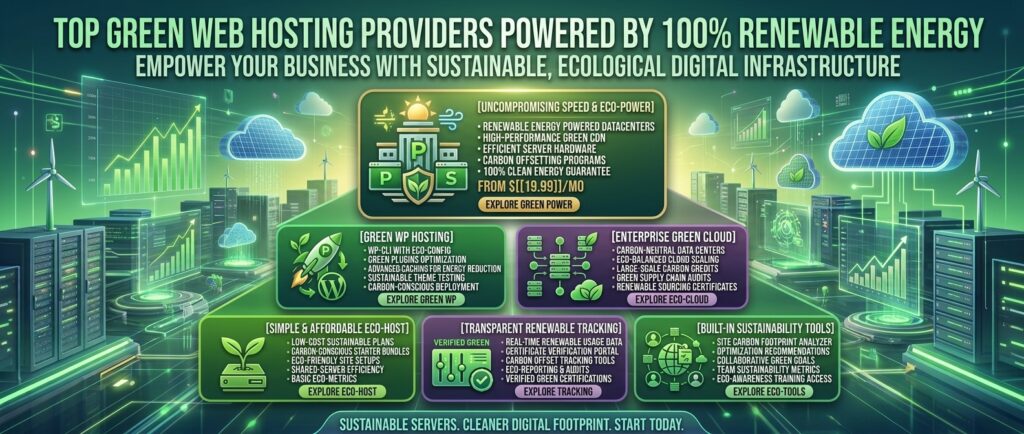
Top green web hosting providers powered by 100 percent renewable energy. For digital entrepreneurs, green-conscious business owners, and digital agencies building web properties across major metropolitan hubs like Texas, New York, California, Washington, and San Francisco, minimizing a digital carbon footprint has become a top priority.
When most people think about carbon emissions, they visualize smoke stacks, commercial aviation, and combustion engines. However, the global internet is an invisible energy monster. Data centers consume immense amounts of electricity globally to power continuous server calculations, storage arrays, and heavy industrial air-conditioning systems required to prevent equipment overheating. In fact, the global data center sector consumes more electricity annually than entire medium-sized nations.
Fortunately, a growing tier of forward-thinking hosting companies has revolutionized the industry. Green web hosting utilizes 100% renewable energy sources—such as wind, solar, and hydroelectric power—alongside energy-efficient hardware infrastructure to power websites cleanly without sacrificing speed or reliability.
This masterclass review guide analyzes the top green web hosting providers powered by renewable energy, breaking down their sustainability practices, infrastructure performance, pricing, and overall value.
What Exactly Is Green Web Hosting and How Does It Work?
Before reviewing specific providers, it is important to understand how a hosting company claims “green” status. There are two primary mechanisms providers use to neutralize their environmental impact:
- Renewable Energy Certificates (RECs) & Carbon Offsets: The most common approach involves purchasing RECs or partnering with organizations like the Bonneville Environmental Foundation (BEF). For every kilowatt-hour (kWh) of electricity the host’s servers pull from the standard power grid, they purchase an equivalent amount of wind or solar energy credits, injecting clean energy back into the grid and offsetting 100% (or even 300%) of their energy footprint.
- Direct Renewable Power & Data Center Efficiency: Elite data centers use direct power purchase agreements (PPAs) with local solar and wind farms, coupled with state-of-the-art server virtualization, low-power multi-core processors, and intelligent containment cooling systems that drastically reduce Power Usage Effectiveness (PUE) ratings.
Top Green Web Hosting Providers Powered by Renewable Energy
1. GreenGeeks — The Gold Standard for 300% Green Web Hosting
GreenGeeks is widely recognized across the industry as the pioneer and leader in eco-friendly web hosting, combining elite performance with an aggressive sustainability model.
- Renewable Energy Commitment: GreenGeeks operates on a 300% green energy match. They calculate the total energy consumed by their servers, cooling arrays, and office staff, and purchase three times that amount in wind energy RECs through the Bonneville Environmental Foundation.
- Infrastructure & Speed: Built on containerized cloud platforms utilizing solid-state NVMe drives, LSCache technology, and eco-friendly server hardware that minimizes electronic waste through aggressive recycling frameworks.
- Extra Eco-Initiatives: Partnered with One Tree Planted to plant a tree for every new website hosted on their platform.
- Pros: Outstanding speed and uptime; industry-leading environmental transparency; robust developer tools.
- Cons: Renewal rates increase after the introductory promotional period expires.
2. DreamHost — Carbon-Neutral Veteran with Eco-Friendly Operations
DreamHost is a legacy independent hosting provider with over two decades of market experience, pairing reliable server architecture with a corporate-wide commitment to carbon neutrality.
- Renewable Energy Commitment: DreamHost operates energy-efficient data centers powered by regional grids leveraging renewable sources. They utilize advanced server hardware equipped with power-efficient processors that draw minimal wattage under load.
- Infrastructure & Speed: 100% SSD-powered storage arrays, custom control panels, and automated WordPress tools delivering reliable Time to First Byte (TTFB) performance.
- Extra Eco-Initiatives: Embraces a permanent remote-work corporate structure for its entire workforce, eliminating thousands of tons of daily commuter-related carbon emissions annually.
- Pros: Industry-leading 97-day money-back guarantee; affordable introductory pricing; transparent carbon-neutral policies.
- Cons: Live chat support response times can occasionally experience brief delays during peak hours.
3. SiteGround — High-Performance Green Hosting Powered by Google Cloud
SiteGround is a premier independent hosting giant beloved by digital agencies and professional publishers, utilizing enterprise cloud infrastructure running entirely on clean energy.
- Renewable Energy Commitment: SiteGround hosts its primary server infrastructure on the Google Cloud Platform (GCP), which has matched 100% of its global electricity consumption with renewable energy purchases since 2017.
- Infrastructure & Speed: Powered by custom-built SuperCacher technology, ultra-fast PHP execution, and distributed edge caching, making it one of the fastest hosting platforms available.
- Extra Eco-Initiatives: Active supporter of global wildlife conservation and environmental preservation foundations, earning multiple green business awards.
- Pros: Exceptional server speed and Core Web Vitals optimization; stellar customer service.
- Cons: Higher renewal rates compared to entry-level budget hosts.
4. HostPapa — Eco-Friendly Hosting Tailored for Small Businesses
HostPapa is a popular, beginner-friendly web hosting provider that makes sustainability a core pillar of its brand identity for small business owners and entrepreneurs.
- Renewable Energy Commitment: HostPapa purchases 100% certified green energy RECs to match every watt of electricity used by its web servers, offices, and data center facilities via the Bonneville Environmental Foundation.
- Infrastructure & Speed: Robust SSD shared and cloud hosting configurations optimized for small business websites, e-commerce stores, and blogs.
- Extra Eco-Initiatives: Actively invests in global green power projects and community-level environmental education initiatives.
- Pros: Very easy onboarding wizard for beginners; reliable 24/7 multilingual support.
- Cons: Upselling of auxiliary add-ons can occasionally clutter the checkout process.
5. InMotion Hosting — Natural Server Cooling and Energy Conservation
InMotion Hosting is a US-based hosting provider known for high-performance servers, developer-friendly flexibility, and innovative energy-saving data center design.
- Renewable Energy Commitment: Incorporates energy-conscious hardware configurations alongside advanced facility management to reduce overall electrical draw.
- Infrastructure & Speed: High-speed NVMe storage clusters, robust security monitoring, and optimized LAMP stacks.
- Extra Eco-Initiatives: Features an advanced natural airflow cooling system in their Los Angeles data center, driving hot air out and pulling cool outside air in to reduce artificial HVAC power consumption by up to 70%. They also partner with Trees for the Future to plant thousands of trees.
- Pros: 100% US-based support; innovative mechanical cooling reducing carbon output; 90-day money-back guarantee.
- Cons: Account verification procedures can occasionally feel rigid for new users.
Comparative Matrix: Top Green Web Hosting Providers
| Hosting Provider | Green Energy Mechanism | Carbon Neutral Status | Starting Price | Money-Back Guarantee |
| GreenGeeks | 300% Wind REC Match | Yes | $2.95 / mo | 30 Days |
| DreamHost | Power-Efficient Hardware / Offsets | Yes | $2.59 / mo | 97 Days |
| SiteGround | Google Cloud 100% Renewable Match | Yes | $3.99 / mo | 30 Days |
| HostPapa | 100% Green Energy RECs | Yes | $2.95 / mo | 30 Days |
| InMotion | Natural Cooling / Eco-Workplace | Partial | $2.29 / mo | 90 Days |
Actionable Tips to Make Your Website Even More Eco-Friendly
Choosing a green hosting provider is a massive step, but optimizing your actual web code and asset delivery reduces server CPU cycles, saving even more electricity:
- Compress and Serve Next-Gen Images: Heavy JPEG and PNG files force servers to transmit more data. Convert your images to modern WebP or AVIF formats to shrink file sizes by up to 60%.
- Deploy an Edge CDN (Content Delivery Network): By routing your web assets through a global CDN like Cloudflare, visitors load your site from the server closest to them (e.g., San Francisco or New York data centers), drastically cutting down long-distance network transmission energy.
- Minimize Database Queries and Bloated Plugins: Unoptimized plugins cause your server’s CPU to work overtime processing PHP requests. Regularly clean your database transients and prune unused plugins.
Frequently Asked Questions (FAQ)
1. What is green web hosting?
Green web hosting is a hosting service that powers its servers and data centers using renewable energy sources (like wind, solar, or hydro) or offsets 100% of its carbon footprint through verified Renewable Energy Certificates (RECs).
2. Is green web hosting more expensive than traditional hosting?
No. Providers like GreenGeeks, DreamHost, and HostPapa offer eco-friendly shared hosting plans starting at competitive introductory rates (under $3.00 per month) that match or beat non-green competitors.
3. How can I verify if a web host is genuinely green?
You can verify a hosting company’s sustainability credentials by checking their verification badge through The Green Web Foundation database (thegreenwebfoundation.org), which tracks independent data center energy inputs.
4. Does green web hosting sacrifice server speed or uptime?
Not at all. Green hosts utilize the same high-performance solid-state NVMe drives, LiteSpeed web servers, and cloud architectures as conventional hosts, ensuring top-tier speed and 99.9%+ uptime.
5. What are Renewable Energy Certificates (RECs)?
RECs are market-based instruments that represent the legal property rights to the environmental benefits of generating one megawatt-hour (MWh) of renewable electricity. Hosts purchase them to fund clean energy grids equal to their usage.
6. Can I host a high-traffic e-commerce store on a green hosting plan?
Yes. Enterprise green providers like SiteGround (powered by Google Cloud) and GreenGeeks offer robust VPS and cloud scaling tiers capable of handling heavy e-commerce transactions and high concurrent traffic.
7. Do green hosting companies offer free SSL certificates?
Yes. All top-tier green hosts (including GreenGeeks, DreamHost, and SiteGround) include free, automated Let’s Encrypt SSL certificates with every hosting plan.
8. What is PUE, and why does it matter for green hosting?
PUE (Power Usage Effectiveness) measures how efficiently a data center uses energy. A lower PUE rating indicates that less energy is wasted on auxiliary systems like facility lighting and artificial cooling.
9. Are there green hosting options for WordPress specifically?
Yes. Providers like GreenGeeks and SiteGround feature managed WordPress plans equipped with built-in server-side caching, automated core updates, and optimized green infrastructures.
10. Which green web hosting provider should I choose to get started?
For the absolute best balance of performance, 300% renewable energy offsetting, and reliable support, GreenGeeks is the top overall recommendation. For heavy business workloads, SiteGround running on Google Cloud is exceptional.
Conclusion
Choosing a web hosting provider powered by 100% renewable energy allows digital entrepreneurs, developers, and businesses across major commercial centers like Texas, New York, California, Washington, and San Francisco to scale their online presence while actively protecting the environment. By partnering with industry pioneers like GreenGeeks, DreamHost, or SiteGround, you can achieve lightning-fast website speeds, rock-solid uptime, and a zero-emission digital footprint.