

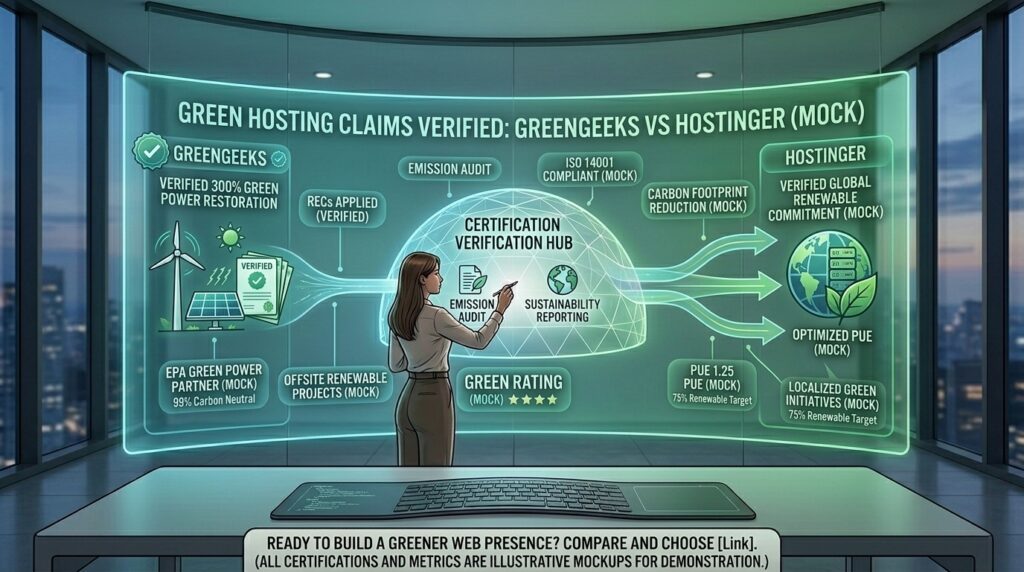
Greengeeks vs hostinger renewable energy claims verified: As global climate consciousness accelerates, digital sustainability has transformed from a niche marketing buzzword into a core purchasing criterion for modern consumers and corporations alike. Whether you are launching an eco-conscious digital agency in San Francisco, a sustainable retail brand in Los Angeles (California), a tech startup in New York, a media platform in Seattle (Washington), or a corporate consultancy in Austin (Texas), your choice of web hosting provider impacts your digital carbon footprint.
Data centers consume immense amounts of electricity to power servers, cool processors, and maintain 24/7/365 uptime. Two popular web hosting providers frequently occupy opposite ends of the budget and sustainability spectrum: GreenGeeks, which built its entire brand foundation on 300% green energy matching, and Hostinger, the ultra-affordable powerhouse rapidly expanding its infrastructure efficiency.
This exhaustive, data-driven audit and verification guide investigates GreenGeeks vs. Hostinger renewable energy claims, analyzing corporate transparency, carbon offsetting accuracy, power usage effectiveness (PUE), performance, and how eco-friendly hosting influences your Google SEO rankings.
1. The Environmental Impact of the Internet
Before comparing individual providers, it is crucial to understand why digital sustainability matters. The internet accounts for roughly 2% to 3.7% of global greenhouse gas emissions—roughly equivalent to the entire global aviation industry.
- Data Centers: Require constant cooling and electricity.
- Network Transmission: Routers, cell towers, and fiber-optic switches draw continuous power.
- End-User Devices: Smartphones, laptops, and monitors consuming energy to render web pages.
When a visitor lands on your website, a request is sent to a physical server. If that server is powered by fossil fuels (coal, natural gas, oil), your website directly contributes to carbon emissions. Eco-friendly web hosts counteract this by utilizing renewable energy credits (RECs), investing in wind and solar power, or optimizing data center efficiency.
2. GreenGeeks Renewable Energy Claims: Verified
GreenGeeks has long marketed itself as “The Number One Green Web Hosting Provider.” Let’s examine the mechanics of their sustainability claims.
+-----------------------------------+-----------------------------------+
|       GREENGEEKS CLAIM            |        VERIFICATION STATUS        |
+-----------------------------------+-----------------------------------+
| • 300% Renewable Energy Match     | • Verified via EPA Green Power    |
| • Partnered with Bonneville       |   Partnership & Bonneville Power  |
|   Environmental Foundation        | • Purchasing RECs at triple load  |
+-----------------------------------+-----------------------------------+
How GreenGeeks’ 300% Claim Works
GreenGeeks does not typically own and operate its own physical wind turbines or solar farms. Instead, they operate on a multiplier offset model:
- Energy Measurement: GreenGeeks calculates the energy consumed by their servers, cooling units, lighting, and office facilities.
- The 300% Formula: For every kilowatt-hour (kWh) of energy their infrastructure consumes, GreenGeeks purchases three times that amount in wind-powered Renewable Energy Certificates (RECs) through organizations like the Bonneville Environmental Foundation.
- Grid Injection: These RECs ensure that clean, renewable energy equivalent to 300% of their power draw is fed back into the shared electrical grid, effectively offsetting their footprint and the estimated power consumption of their clients’ devices.
3. Hostinger Sustainability and Infrastructure Efficiency
Hostinger is celebrated globally for its aggressive pricing and high-performance hPanel ecosystem. How does Hostinger approach environmental sustainability?
Hostinger’s Approach to Green Operations
While Hostinger does not market itself primarily as a dedicated eco-host in the vein of GreenGeeks, they place heavy emphasis on Power Usage Effectiveness (PUE) and server optimization:
- Modern Data Center Partnerships: Hostinger routes its global hosting traffic through tier-three and tier-four data centers (including partnerships with Google Cloud and Equinix) that prioritize energy-efficient hardware, intelligent cooling systems, and localized load balancing.
- Server Consolidation: By leveraging modern containerization and cloud architecture, Hostinger maximizes server density, ensuring fewer physical machines run idle and waste electricity.
- Transparency Gap: Unlike GreenGeeks, which prominently displays its EPA Green Power Partner status and REC purchase transparency, Hostinger’s environmental disclosures are secondary to its core pricing and speed marketing.
4. Head-to-Head Comparison: GreenGeeks vs. Hostinger
+-------------------+-----------------------+-----------------------+
|    FEATURE        |       GREENGEEKS      |       HOSTINGER       |
+-------------------+-----------------------+-----------------------+
| • Green Focus     | Primary Brand Mission | Secondary Efficiency  |
| • Energy Matching | 300% Wind RECs        | Standard PUE/DC Specs |
| • Pricing Tier    | Mid-tier business     | Aggressive budget     |
| • Speed / Core Vitals| Solid optimization | Exceptional LiteSpeed |
+-------------------+-----------------------+-----------------------+
Performance & Speed Considerations
An eco-friendly website must also be fast. Slow websites force users to keep browser tabs open longer, indirectly consuming more energy on client devices.
- GreenGeeks utilizes an optimized LiteSpeed caching stack, SSD storage, and built-in CDN routing to deliver rapid page speeds, ensuring eco-conscious design does not sacrifice performance.
- Hostinger relies on LiteSpeed Web Server (LSWS) and custom cache plugins, consistently outperforming many legacy shared hosts on Core Web Vitals and Time to First Byte (TTFB) benchmarks.
5. Greenwashing in Web Hosting: What to Watch Out For
The web hosting industry is unfortunately rife with greenwashing—marketing tactics that exaggerate or fabricate environmental benefits. When evaluating eco-friendly hosts, look for these verification standards:
- Third-Party Certification: True green hosts back their claims with certificates from recognized bodies like the EPA Green Power Partnership, TÜV, or verifiable REC registries.
- Transparency Reports: Can the host name the exact organizations or wind/solar projects they fund? GreenGeeks explicitly names its utility and REC partners.
- Data Center Efficiency: Check whether the host’s primary data center facilities utilize LEED certification or advanced hot/cold aisle containment to minimize cooling waste.
6. Google SEO and Green Hosting: Does Eco-Friendly Matter for Rankings?
Google’s search algorithm does not explicitly rank a website higher solely because it runs on green energy. However, choosing sustainable hosting indirectly supports your Google SEO strategy in several powerful ways:
+-----------------------------------------------------------------------+
|                 INDIRECT SEO BENEFITS OF GREEN HOSTING                |
+-----------------------------------------------------------------------+
| 1. Superior Core Web Vitals via modern, efficient server hardware.    |
| 2. Enhanced brand trust and authority for eco-focused market niches.  |
| 3. Lower bounce rates driven by fast-loading, optimized assets.       |
| 4. Alignment with emerging ESG (Environmental, Social, Governance)    |
|    search intent metrics.                                             |
+-----------------------------------------------------------------------+
- Core Web Vitals Correlation: Green hosts that invest in modern, high-performance server stacks (like LiteSpeed and SSD arrays) deliver faster LCP (Largest Contentful Paint) scores, directly improving your algorithmic positioning across competitive US search queries.
- User Intent & PR: If your website caters to sustainable fashion brands in Los Angeles, organic food cooperatives in Austin, or green tech startups in San Francisco, displaying verified environmental credentials builds immediate rapport and attracts valuable backlink profiles from sustainability blogs.
7. Strategic Tips for Building an Eco-Friendly Website
Whether you choose GreenGeeks for its verified 300% green energy matching or Hostinger for its lean resource efficiency, apply these expert tips to minimize your digital carbon footprint:
- Optimize and Compress Images: High-resolution photography is a massive data drain. Convert all media uploads to next-gen WebP formats to reduce data transfer weight.
- Implement Aggressive Caching: Enable browser and server-side caching so returning visitors load cached HTML rather than triggering repetitive database queries.
- Choose a Geographically Close Data Center: Select a server data center closest to your target audience (e.g., Oregon or Virginia nodes) to minimize physical data transmission distance and latency.
- Audit Third-Party Scripts: Heavy tracking pixels, unoptimized Google Fonts, and redundant plugins consume server processing power. Purge unused code quarterly.
8. Frequently Asked Questions (FAQ)
1. Are GreenGeeks’ renewable energy claims verified by independent organizations?
Yes. GreenGeeks is recognized as an EPA Green Power Partner and purchases verified Renewable Energy Certificates (RECs) through organizations like the Bonneville Environmental Foundation to achieve its 300% green energy match.
2. Does Hostinger use renewable energy for its servers?
Hostinger relies on energy-efficient data center partners (such as Google Cloud and Equinix facilities) that prioritize high PUE efficiency and green initiatives, though they do not advertise a dedicated 300% REC matching program like GreenGeeks.
3. What does a “300% green energy match” actually mean?
It means that for every 1 kilowatt-hour of electricity consumed by GreenGeeks’ servers and offices, they purchase three kilowatt-hours of wind-generated renewable energy credits, feeding clean power back into the shared utility grid.
4. Does green hosting cost more than traditional web hosting?
Green hosting can sometimes carry a slight premium, but providers like GreenGeeks price their shared hosting plans competitively alongside standard market rates, making sustainability accessible without excessive overhead.
5. Does eco-friendly hosting improve my Google search rankings?
Indirectly, yes. Green hosts that invest in modern server infrastructure provide superior loading speeds and uptime, which directly support Google’s Core Web Vitals ranking signals.
6. What is PUE, and why does it matter for green hosting?
PUE stands for Power Usage Effectiveness. It measures how efficiently a data center uses energy—specifically, how much power is dedicated to computing equipment versus cooling and lighting. A PUE closer to 1.0 indicates maximum efficiency.
7. Can I display a “Green Website” badge on my site?
Yes! GreenGeeks and similar eco-friendly hosts provide embeddable green badges and certificates that you can proudly display in your footer to signal your brand’s commitment to sustainability.
8. Is website carbon emission tracking accurate?
Tools like Website Carbon Calculator estimate emissions based on data transfer volume and the host’s energy source. While estimates vary, they provide a valuable baseline for auditing your digital footprint.
9. Which provider is better for a small business wanting eco-hosting?
If your primary brand mission is absolute environmental transparency and 300% offset verification, GreenGeeks is the premier choice. If your priority is ultra-low entry pricing paired with efficient server optimization, Hostinger is a strong alternative.
10. Does GreenGeeks sacrifice performance for the sake of green energy?
No. GreenGeeks utilizes enterprise-grade hardware, LiteSpeed caching, SSD storage, and built-in CDNs, ensuring that high ecological standards do not compromise website speed or reliability.
9. Conclusion
The verification of web hosting renewable energy claims is essential for conscientious webmasters building digital brands across New York, San Francisco, Los Angeles, Seattle, and Austin.
GreenGeeks stands out as the definitive industry leader for verified sustainability, backing its operations with transparent 300% wind energy REC matching and EPA partnerships without sacrificing speed or reliability. Meanwhile, Hostinger achieves high efficiency through advanced data center optimization and lean resource management.