

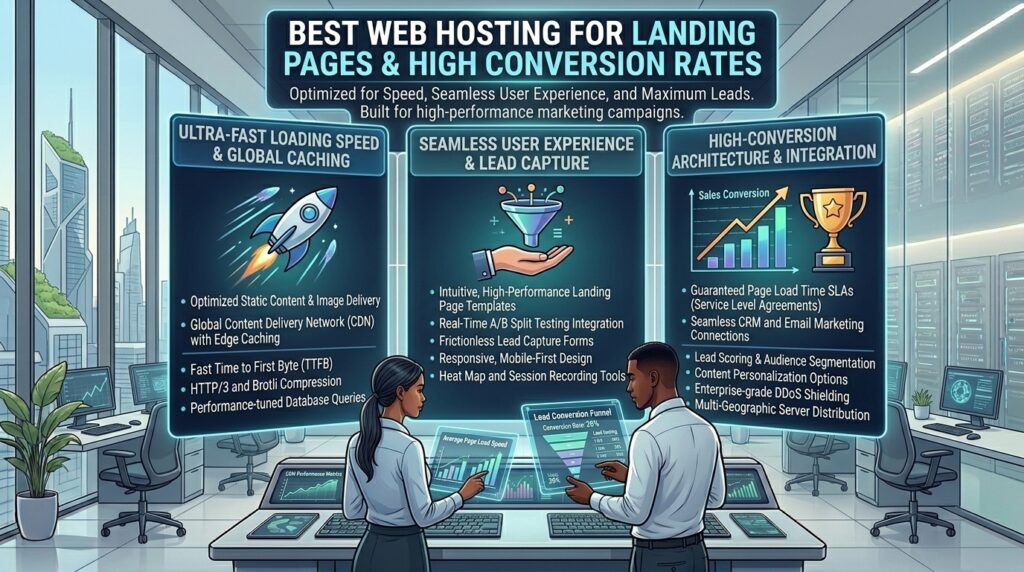
What is the fast web hosting for landing pages with high conversion rates? In modern digital marketing, every single millisecond counts. Whether you are running aggressive paid advertising campaigns (Google Ads, Meta, LinkedIn, TikTok) or capturing high-intent organic search traffic across competitive metropolitan hubs like Texas, New York, California, Washington, and San Francisco, your landing page is the direct gatekeeper to your revenue.
When a prospective customer clicks your advertisement or organic link, they expect an instantaneous response. If your landing page takes 3 or 4 seconds to render, user frustration spikes, bounce rates skyrocket, and your conversion rates plummet. Worse yet, slow server response times—measured as Time to First Byte (TTFB)—directly penalize your Google search rankings under core user-experience algorithms.
This exhaustive guide explores why lightning-fast web hosting is the secret weapon of high-converting landing pages, reviews the top-performing infrastructure providers on the market, and provides an expert technical roadmap to maximize your search visibility and return on ad spend (ROAS).
1. Why Conversion Rates Depend Directly on Web Hosting Speed
Many growth marketers and business owners invest thousands of dollars optimizing ad copy, headline hooks, call-to-action (CTA) buttons, and color schemes, yet host their landing pages on cheap, unoptimized shared servers. This creates a fatal bottleneck:
- The Psychology of the 2-Second Window: Studies by Google and Amazon consistently show that mobile users abandon web pages if they take longer than 2 to 3 seconds to load. A sluggish server creates immediate friction, destroying buyer trust before they even read your headline.
- The Invisible Ad Spend Tax: If you run paid media campaigns, slow hosting literally burns your marketing capital. If your landing page lags, your cost-per-acquisition (CPA) increases because fewer visitors stick around long enough to fill out a lead form or checkout.
- Core Web Vitals and SEO Rankings: Google’s ranking algorithms judge your pages based on Largest Contentful Paint (LCP), Interaction to Next Paint (INP), and Cumulative Layout Shift (CLS). If your host suffers from poor server response speeds, your organic search visibility drops, forcing you to rely exclusively on expensive paid traffic.
- Handling Sudden Traffic Surges: If a Facebook ad goes viral or a Google campaign spikes during peak hours, unoptimized shared hosting will crash under concurrent requests, resulting in blank error screens (504 Gateway Timeouts) and lost leads.
2. Essential Technical Features to Demand for High-Conversion Hosting
When evaluating web hosting for high-converting landing pages, look past marketing hype and demand these core technical specifications:
- NVMe SSD Storage: Legacy mechanical drives introduce processing delays during database queries. Solid-state NVMe storage reads and writes files up to 10x faster, ensuring your landing page scripts execute instantly.
- LiteSpeed Web Servers & Built-In Caching: Look for hosts utilizing modern LiteSpeed architecture paired with native caching plugins (like LSCache), which handle high-volume traffic spikes and script execution far more efficiently than standard Apache setups.
- Global Content Delivery Network (CDN) Integration: Essential for serving your landing page images, fonts, and scripts from edge servers closest to your regional audience (whether they are browsing from Manhattan, Austin, or Seattle).
- Isolated Resource Containers: Avoid multi-tenant shared hosting where a neighboring website’s traffic spike or security flaw can degrade your landing page performance.
3. Top Web Hosting Providers Ranked for High-Conversion Landing Pages
Based on real-world speed benchmarks, TTFB latency tests, uptime reliability, and marketing ecosystem integration, here are the top hosting options on the market:
A. Hostinger (Best Overall Value and Speed for Landing Pages)
Hostinger is widely recognized as a performance leader for high-speed web hosting, utilizing cutting-edge infrastructure at an accessible price point.
- Why it shines for Landing Pages: Hostinger leverages LiteSpeed web servers, NVMe storage, and global CDN integration to deliver sub-second page loads. Their custom hPanel allows marketers to deploy landing page builders or WordPress instances instantly.
- Best For: Solo entrepreneurs, agencies, and performance marketers launching high-speed campaigns on a smart budget.
- Pricing: Introductory plans start around $2.49 to $2.99/month.
B. ScalaHosting (Best Cloud VPS Performance for High-Volume Campaigns)
For scaling enterprise marketing campaigns that drive thousands of simultaneous clicks, ScalaHosting provides powerful, fully managed cloud VPS infrastructure.
- Why it shines for Landing Pages: You get dedicated cloud resources (unshared RAM and CPU cores) ensuring your landing pages never lag during heavy traffic surges. Their SPanel dashboard and built-in security shield make high-end cloud power user-friendly.
- Best For: Media buyers, agencies, and high-volume e-commerce brands running large-scale PPC ads.
- Pricing: Managed cloud VPS plans start around $14.95/month.
C. SiteGround (Best Managed Mid-Range Host for WordPress Marketers)
Powered by Google Cloud infrastructure, SiteGround is famous for elite reliability, fast server response times, and exceptional built-in speed tools.
- Why it shines for Landing Pages: SiteGround features a proprietary Speed Optimizer plugin, a 3-layer caching system, and automated daily backups, making it a favorite for marketers building landing pages via WordPress and Elementor or Thrive Architect.
- Best For: Businesses relying on WordPress marketing funnels who want hands-off reliability.
- Pricing: Introductory plans start around $3.95 to $5.95/month.
D. Vercel / Netlify (Best Modern JAMstack Hosting for Static Marketing Pages)
For high-tech SaaS products or custom-coded HTML/JavaScript landing pages, modern edge networks like Vercel and Netlify offer unmatched speed.
- Why it shines for Landing Pages: Your landing pages are compiled and distributed globally across edge servers, rendering instantly with virtually zero server latency.
- Best For: Developer-driven marketing teams deploying high-speed static or framework-based landing pages.
- Pricing: Generous free tiers with scalable team plans.
4. Masterclass: Maximizing Google SEO and Conversion Rates
Achieving fast server hosting is step one. To turn your landing page into an organic search magnet and a conversion machine, implement these advanced optimization strategies:
Optimizing Time to First Byte (TTFB) and Core Web Vitals
To satisfy Google’s mobile-first indexing and keep your bounce rates low:
- Maintain a TTFB under 200 milliseconds by leveraging server-side edge caching.
- Eliminate render-blocking JavaScript in your page header.
- Compress all hero banner graphics, illustrations, and product photos into next-gen WebP or AVIF formats.
Structuring Clean URL Silos for Campaign SEO
If you run multiple targeted landing pages for different cities (e.g., Texas, New York, California) or specific buyer personas, organize them in a clean directory hierarchy (e.g., [yoursite.com/campaign/san-francisco-legal-lead](https://yoursite.com/campaign/san-francisco-legal-lead)). Clean structures prevent duplicate content penalties and pass link equity efficiently.
Tracking Conversions Without Slowing Down Your Site
Marketers often ruin their site speed by embedding dozens of heavy third-party tracking scripts (Meta Pixels, TikTok Pixels, Google Tag Manager, heatmaps). Streamline your tracking by consolidating tags through Google Tag Manager and loading non-essential marketing scripts asynchronously.
5. Frequently Asked Questions (FAQ)
1. How fast should my landing page load to maximize conversions?
To achieve optimal conversion rates, your landing page should load fully in under 2 seconds, with a Server Response Time (TTFB) under 200 milliseconds. Every second of delay past 2 seconds can drop conversions by up to 20%.
2. Can I use cheap $3/month shared hosting for high-traffic ad landing pages?
While cheap shared hosting works for low-traffic sites, it is heavily discouraged for active ad campaigns. Shared servers experience resource contention, meaning a sudden spike in ad traffic can crash your page or slow it down, wasting your ad budget.
3. What is Time to First Byte (TTFB), and why is it crucial for conversion rates?
TTFB measures how long a user’s browser waits before receiving the first byte of data from your web hosting server. A low TTFB ensures your landing page starts rendering immediately on the user’s screen.
4. Is WordPress good for high-converting landing pages?
Yes, provided it is hosted on a high-performance platform like Hostinger or SiteGround and paired with a clean page builder (like Elementor or Gutenberg) rather than bloated, slow-loading themes.
5. Do I need a Content Delivery Network (CDN) if my host is already fast?
Yes. A CDN caches your static images and scripts across global edge data centers, ensuring that prospective buyers visiting from across the country experience identical sub-second page load speeds.
6. How do tracking pixels (Meta, Google Ads) affect my landing page speed?
Heavy third-party tracking pixels block the main browser thread while loading. You can mitigate this impact by using asynchronous tag management systems and optimizing your server response speed.
7. What is the difference between shared hosting and cloud VPS for marketing campaigns?
Shared hosting places your landing page on a server with hundreds of other sites sharing resources. Cloud VPS (Virtual Private Server) gives you dedicated, isolated CPU and RAM resources, ensuring consistent speed during traffic surges.
8. Will improving my landing page hosting speed improve my Google Ads Quality Score?
Yes. Google Ads evaluates landing page experience (including page speed and mobile responsiveness) when calculating your Quality Score, which directly lowers your cost-per-click (CPC).
9. How can I test if my landing page hosting is fast enough?
You can audit your landing page speed, mobile performance, and server response time using free diagnostics tools like Google PageSpeed Insights, GTmetrix, and WebPageTest.org.
10. Should I use a dedicated landing page builder or self-hosted WordPress?
Dedicated builders (like Unbounce or Leadpages) offer quick drag-and-drop setup but limit SEO flexibility. Self-hosted WordPress on a fast host gives you total SEO ownership, custom content silos, and zero monthly platform subscription fees.
6. Conclusion
Your landing page is the ultimate engine of your digital marketing and customer acquisition strategy. Relying on sluggish, unoptimized web hosting wastes valuable advertising dollars, frustrates prospective buyers, and hurts your organic search rankings.