

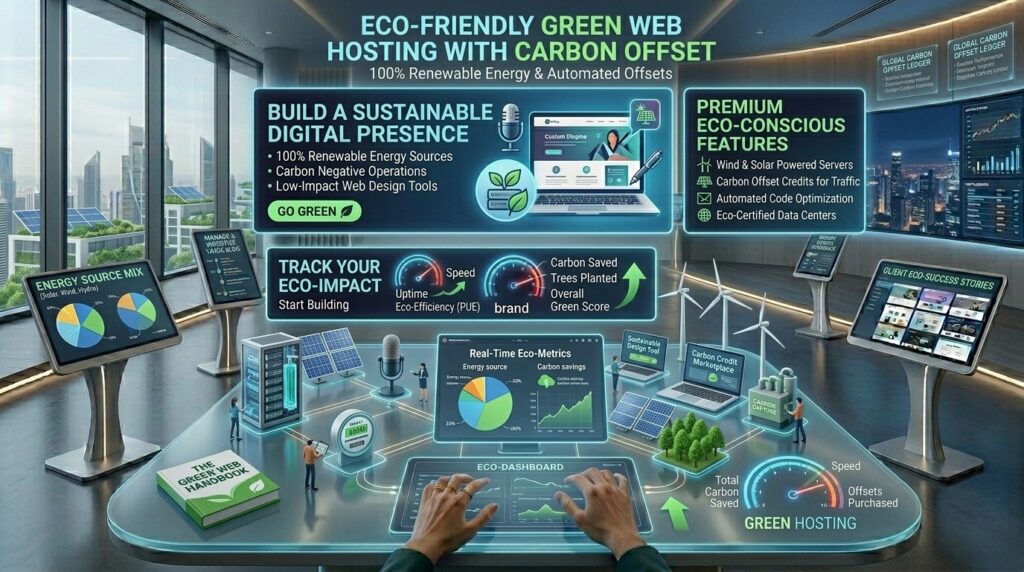
What is the eco friendly green web hosting with carbon offset? The digital economy has a massive, often invisible physical footprint. Millions of heavy server racks hum 24 hours a day, 7 days a week, consuming immense amounts of electricity to store files, process user requests, and stream media. In fact, data centers and global communication networks account for a significant percentage of global carbon dioxide emissions—rivaling the commercial aviation industry.
For modern businesses, eco-conscious creators, and green tech brands operating across major hubs like Texas, New York, California, Washington, and San Francisco, your digital infrastructure matters. If your corporate ethos champions sustainability, relying on fossil-fuel-powered data centers creates an operational contradiction.
Fortunately, a new wave of eco-friendly green web hosting providers utilizes renewable energy credits (RECs), direct power purchase agreements, and carbon offset programs to ensure your website runs with a net-zero (or even net-negative) carbon footprint.
This comprehensive guide explores the best green web hosting providers, how carbon offsets work in tech, and technical strategies to optimize your green website for Google SEO dominance.
1. Understanding Green Web Hosting and Carbon Offsets
Before choosing a sustainable host, it is vital to understand how web hosting companies achieve “green” status. Not all eco-friendly claims are created equal. The industry generally relies on three core mechanisms:
- Renewable Energy Certificates (RECs): Many hosting providers purchase RECs from certified green energy generators (such as wind or solar farms) to match 100%—or even 300%—of the electricity consumed by their servers and offices. When a provider buys 300% offsets (like GreenGeeks), they put triple the energy their servers consume back into the public grid as renewable power.
- Direct Power Purchase Agreements (PPAs) & Green Grid Data Centers: The gold standard of green hosting involves data centers powered directly by local renewable grids (such as hydroelectric power in Scandinavia or geothermal and solar energy in specific US regions).
- Power Usage Effectiveness (PUE) Optimization: Eco-conscious hosts use ultra-efficient server hardware, intelligent AI-driven cooling systems, and natural free-cooling (such as utilizing cold ambient air or local water sources) to minimize wasted energy.
2. Top Green Web Hosting Providers Ranked for Performance and Sustainability
Based on verified green credentials, infrastructure speed, uptime reliability, and overall value, here are the top eco-friendly web hosts on the market:
A. GreenGeeks (Best Overall Green Hosting and 300% Carbon Offset)
GreenGeeks has been a pioneer in sustainable web hosting for over a decade and remains the industry benchmark for eco-conscious web infrastructure.
- Why it shines for Sustainability: GreenGeeks works with the Bonneville Environmental Foundation to match three times the energy their data centers consume with wind-powered Renewable Energy Certificates (RECs), making them officially carbon-negative.
- Performance & Features: Beyond their green mission, they offer robust shared, WordPress, and VPS hosting featuring built-in caching, solid-state NVMe drives, free SSL certificates, and nightly automated backups.
- Pricing: Introductory plans start at around $2.95/month.
B. SiteGround (Best Performance Using Google Cloud’s Renewable Infrastructure)
SiteGround is universally praised for elite speed and reliability, powered natively by the Google Cloud Platform.
- Why it shines for Sustainability: Google Cloud has matched 100% of its global electricity consumption with renewable energy purchases, and its data centers operate at twice the energy efficiency of traditional enterprise facilities. SiteGround pairs this green hardware with custom energy-saving PHP execution layers.
- Performance & Features: Ultrafast server response times, superior staging tools, free CDN integration, and legendary 24/7 customer support.
- Pricing: Introductory plans start around $2.99/month.
C. Infomaniak (The European Gold Standard for True Green Energy)
For businesses targeting international audiences or valuing strict European environmental standards, Swiss-based Infomaniak is a powerhouse.
- Why it shines for Sustainability: Infomaniak data centers run entirely on local hydroelectric and solar energy without relying on paper-based carbon offsets. They achieve a world-class Power Usage Effectiveness (PUE) rating of 1.08 using natural free-cooling from lake water.
- Performance & Features: Extreme privacy compliance, ISO 14001 certification, and high-performance cloud server options.
- Pricing: Competitive mid-to-high tier pricing based on customized cloud configurations.
D. HostPapa (Best Eco-Friendly Hosting for Small Businesses)
HostPapa positions environmental responsibility at the core of its corporate model, offering a feature-rich platform tailored for growing brands.
- Why it shines for Sustainability: HostPapa purchases 100% green energy certificates to offset the electricity used by their servers, data centers, and corporate offices through certified global environmental projects.
- Performance & Features: Unmetered bandwidth, user-friendly control panels, free domain transfers, and robust security suites.
- Pricing: Introductory plans start around $2.95/month.
3. Essential Technical Requirements for Sustainable Hosting
When choosing a green host, ensure your platform balances ecological commitments with high-speed technical performance:
- Green Web Foundation Verification: Check if your prospective host is listed in the Green Web Foundation database (
thegreenwebfoundation.org), which independently audits whether a data center runs on green energy. - NVMe SSD Storage and Caching: Energy-efficient servers must still process queries quickly. Look for hosts utilizing NVMe drives and object caching (Redis/Memcached) to minimize server active-processing time.
- Global CDN Integration: A Content Delivery Network caches your site closer to your users, reducing the physical distance data must travel across power-hungry internet transit networks.
4. Masterclass: Maximizing Google SEO for Eco-Friendly Websites
Sustainability is an incredible unique selling proposition (USP). Integrating your green mission with a robust technical SEO strategy allows you to capture conscious consumers searching Google for ethical brands.
Targeting Sustainable and Green Keywords
Incorporate eco-friendly search terms into your metadata, H1 tags, and content strategy (e.g., “Sustainable business consulting in San Francisco” or “Eco-friendly e-commerce platform”). Highlighting your green hosting credentials in your brand story builds trust and authority.
Optimizing Core Web Vitals to Save Energy
An energy-efficient website is inherently a fast website. Bulky, unoptimized JavaScript and massive image files force user devices (smartphones and laptops) to burn more battery power to render your page. By compressing assets, implementing lazy loading, and utilizing green caching, you reduce both your server’s energy consumption and the visitor’s end-device power usage.
Building Backlinks from Eco-Directories
Earn high-authority backlinks by registering your site on verified green directories, sustainability blogs, and climate-tech resource hubs. These niche-specific backlinks signal strong topical relevance to Google’s search crawlers.
5. Frequently Asked Questions (FAQ)
1. What is green web hosting, and how does it work?
Green web hosting refers to web hosting services that take active measures to neutralize or eliminate the environmental impact of their servers. This is achieved either by powering data centers directly with renewable energy (solar, wind, hydro) or by purchasing Renewable Energy Certificates (RECs) to offset electricity usage.
2. Are carbon offsets in web hosting legitimate?
Yes, provided the hosting company partners with recognized environmental organizations (such as the Bonneville Environmental Foundation or Green-e) to purchase verified Renewable Energy Certificates that fund new renewable energy generation on public grids.
3. Does green web hosting cost more than traditional hosting?
Not necessarily. Leading eco-friendly hosts like GreenGeeks and Hostinger offer introductory shared plans priced competitively between $2.50 and $3.00 per month, proving that sustainability does not require a luxury budget.
4. Does green hosting compromise website speed or performance?
No. Modern green hosts utilize enterprise-grade hardware, SSD/NVMe storage, and optimized cloud architectures. In many cases, green hosts use newer, more energy-efficient server processors that outperform older, power-hungry legacy hardware.
5. How can I verify if my web hosting provider is genuinely green?
You can copy your website URL and paste it into the Green Web Foundation search tool (thegreenwebfoundation.org). It queries independent registries to verify whether your hosting provider’s data center runs on verified green power.
6. Can I get a badge to show my visitors that my site is green?
Yes. Most major green hosts provide embeddable website badges (e.g., “Powered by 300% Renewable Green Energy”) that you can display in your footer to signal your brand’s commitment to sustainability to prospective customers.
7. Does choosing green hosting improve my Google search rankings?
While Google’s core ranking algorithm does not explicitly give a ranking boost solely for using green energy, green hosting practices naturally align with high performance, fast Core Web Vitals, and efficient code—all of which directly improve your search rankings.
8. What is PUE, and why does it matter for green hosting?
PUE stands for Power Usage Effectiveness. It measures how efficiently a data center uses energy (specifically, how much power is used by computing equipment versus cooling systems). A PUE closer to 1.0 indicates near-zero wasted energy on infrastructure cooling.
9. Can I host a high-traffic e-commerce store on green hosting?
Yes. Eco-friendly hosts offer scalable solutions ranging from managed WordPress and cloud instances to high-performance VPS and dedicated servers capable of handling heavy e-commerce traffic and transactions.
10. How do data center cooling technologies impact the environment?
Traditional air-conditioned data centers consume massive amounts of electricity. Eco-friendly data centers reduce this impact by using natural free-cooling methods, geothermal temperature regulation, or advanced liquid immersion cooling to drastically cut energy waste.
6. Conclusion
Switching to an eco-friendly green web hosting provider is a powerful, tangible step toward reducing your digital carbon footprint without sacrificing performance, uptime, or budget. Whether you choose the carbon-negative infrastructure of GreenGeeks, the Google Cloud-backed efficiency of SiteGround, or the European hydroelectric power of Infomaniak, aligning your website’s technical foundation with your environmental values builds profound consumer trust.