

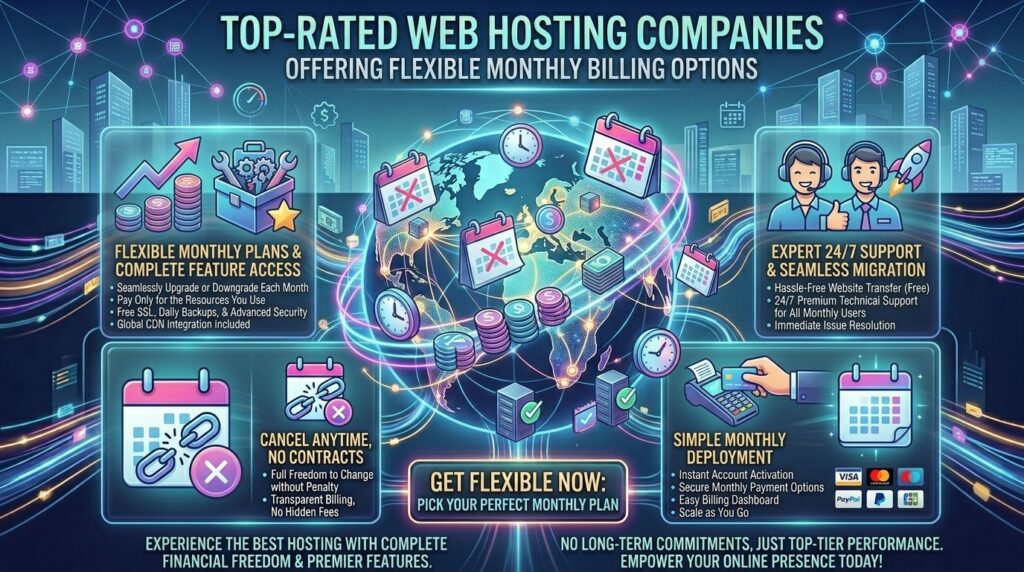
Best web hosting companies offering flexible monthly billing options. When shopping for web hosting, you are almost always greeted by massive discount numbers—”$1.99 per month!” or “$2.99 per month!” However, if you read the fine print, you will quickly discover a catch: those rock-bottom rates require committing to an upfront 1-year, 2-year, or 3-year contract, forcing you to pay for the entire term all at once.
For entrepreneurs, freelance developers, small business owners, and digital creators operating across major commercial hubs like Texas, New York, California, Washington, and San Francisco, sinking hundreds of dollars into multi-year contracts for unproven projects or short-term client campaigns is a poor cash-flow strategy. Sometimes, you need the financial flexibility of true month-to-month hosting.
This comprehensive masterclass review guide analyzes the best web hosting companies offering flexible monthly billing options, breaking down their actual month-to-month pricing, structural features, performance benchmarks, and overall value.
Why Flexible Monthly Billing Matters For Your Cash Flow
Before reviewing individual platforms, let’s explore why selecting a month-to-month hosting model can protect your financial resources and operational agility:
- Zero Upfront Capital Commitment: Instead of paying $300 to $500 upfront for a multi-year lock-in, monthly billing lets you pay a small recurring fee, keeping your working capital free for marketing, software, and inventory.
- Ideal for Short-Term & Experimental Projects: If you are testing a minimum viable product (MVP), running a seasonal marketing campaign, or prototyping a client design, monthly hosting allows you to cancel anytime without wasting prepaid months.
- Risk Mitigation: If a hosting provider’s customer service or server performance fails to meet your expectations, you can easily migrate away at the end of the billing cycle without losing hundreds of prepaid dollars.
Top 5 Web Hosting Providers with Flexible Monthly Billing
1. DreamHost — The Undisputed King of Monthly WordPress Hosting
DreamHost is an independent, WordPress-endorsed hosting veteran that stands completely apart from competitors by offering a genuine, low-cost month-to-month hosting tier without punishing you with steep setup fees.
- Monthly Billing Structure: Allows true month-to-month billing starting at a highly affordable rate (typically around $4.99/mo) with no long-term contracts.
- Performance & Infrastructure: Custom-built dashboard, solid-state drive (SSD) storage, and unmetered bandwidth allowances.
- Key Features: Free domain privacy protection (which other hosts charge extra for), automated WordPress migrations, free SSL certificates, and an industry-leading 97-day money-back guarantee.
- Pros: True month-to-month flexibility; incredible 97-day refund window; free privacy protection included.
- Cons: Custom control panel interface requires a brief adjustment period for users accustomed strictly to standard cPanel layouts.
2. Hostinger — High-Performance Monthly Hosting (With a Small Setup Note)
Hostinger delivers blazing-fast speeds backed by LiteSpeed server infrastructure, offering flexible payment cycles including month-to-month options.
- Monthly Billing Structure: Available on shared plans for users who prefer month-to-month payments, though it typically incurs a nominal one-time setup fee to offset short-term provisioning.
- Performance & Infrastructure: NVMe storage arrays, built-in server-side caching, and global Content Delivery Network (CDN) integration.
- Key Features: Custom
hPanelcontrol dashboard, automated weekly backups, robust security shielding, and 24/7 live chat support. - Pros: Elite speed-to-price ratio; modern interface; handles traffic spikes exceptionally well.
- Cons: Monthly plans feature a standard setup fee that isn’t applied to multi-year upfront contracts.
3. Namecheap — Budget-Friendly Monthly Shared Hosting
Namecheap is widely celebrated for low-cost domain registration and reliable web hosting, offering accessible monthly payment structures for budget-conscious creators.
- Monthly Billing Structure: Shared hosting packages can be toggled to a monthly billing cycle with straightforward checkout terms.
- Performance & Infrastructure: Reliable cloud-backed storage infrastructure ensuring steady uptime, managed via traditional cPanel.
- Key Features: Hosting for up to 3 websites on base tiers, free automatic SSL installation, unmetered bandwidth, and robust privacy protection.
- Pros: Very affordable baseline monthly cost; user-friendly cPanel dashboard; easy WordPress installation.
- Cons: Renewal rates and monthly thresholds are slightly less optimized than multi-year commitments.
4. HostGator — Reliable Month-to-Month Shared Hosting Plans
HostGator is a legacy hosting giant that maintains dedicated month-to-month billing cycles across its shared hosting tiers, making it popular for beginner bloggers and small enterprises.
- Monthly Billing Structure: Clear month-to-month billing options available across Hatchling, Baby, and Business shared plans.
- Performance & Infrastructure: Standard SSD storage blocks, unmetered data transfers, and reliable uptime history.
- Key Features: Free SSL certificates, 1-click WordPress script installers, malware scanning tools, and 24/7 phone/chat support.
- Pros: Easy setup workflows; robust customer support channels; flexible billing intervals.
- Cons: Monthly pricing reflects standard retail rates without multi-year promotional discounts.
5. Cloudways — Pay-As-You-Go Cloud Hosting with Absolute Flexibility
For users requiring dedicated cloud servers rather than shared hosting, Cloudways offers an elite, utility-style monthly billing model.
- Monthly Billing Structure: Pay-as-you-go hourly billing aggregated into a single monthly invoice. You only pay for the exact hours your server is active, with zero long-term contracts.
- Performance & Infrastructure: Deploys your choice of DigitalOcean, AWS, or Google Cloud Platform instances backed by NVMe storage and advanced caching stacks (Redis, Varnish).
- Key Features: Dedicated server resources, 1-click scaling, automated backups, staging environments, and advanced security monitoring.
- Pros: Total resource isolation; scale up or down dynamically; cancel anytime with zero cancellation fees.
- Cons: Requires a basic understanding of server management compared to traditional shared hosting.
Comparative Matrix: Monthly Billing Hosting Providers
| Hosting Provider | Monthly Plan Available? | Setup Fee on Monthly? | Primary Infrastructure | Starting Monthly Price |
| DreamHost | Yes (True Monthly) | No Setup Fee | SSD Shared / WordPress | ~$4.99 / mo |
| Hostinger | Yes (Month-to-Month) | Yes (Nominal Fee) | NVMe / LiteSpeed | ~$11.99 / mo |
| Namecheap | Yes (Monthly Toggle) | No Setup Fee | cPanel Shared SSD | ~$4.48 / mo |
| HostGator | Yes (Hatchling/Baby) | No Setup Fee | Standard Shared SSD | ~$12.95 / mo |
| Cloudways | Yes (Hourly / Monthly) | No Setup Fee | Managed Cloud VPS | ~$14.00 / mo |
Best Practices When Choosing Monthly Web Hosting
Managing your web hosting on a month-to-month schedule requires a slightly different strategic approach than locking into a 3-year contract. Follow these professional recommendations:
- Watch Out for Setup Fees: Some hosts charge a one-time setup fee for month-to-month plans to offset initial provisioning overhead. Factor this into your initial budget calculation.
- Enable Auto-Pay and Payment Alerts: Because monthly invoices recur frequently, ensure your credit card on file is up to date. Missing a monthly billing cycle can result in automated account suspension and temporary site downtime.
- Evaluate Long-Term Cost Projections: Monthly billing is fantastic for flexibility, but if you plan to keep a stable website running for 3 to 5 years, multi-year plans eventually become more cost-effective. Use monthly hosting strategically during your project’s validation phase.
- Maintain Independent Backups: No matter your billing cycle, always download independent site backups locally or store them on a separate cloud drive to maintain complete ownership of your data.
Frequently Asked Questions (FAQ)
1. What is monthly web hosting (month-to-month hosting)?
Monthly web hosting is a billing arrangement where you pay for your hosting service one month at a time, allowing you to cancel or change your plan at any moment without penalty.
2. Why do most web hosts push multi-year contracts?
Hosting companies offer deep discounts on multi-year contracts to secure upfront cash flow and long-term customer commitment, whereas monthly plans involve higher administrative overhead.
3. Is monthly web hosting more expensive than yearly hosting?
Yes. Because you miss out on multi-year promotional discounts, monthly hosting plans are generally billed at standard retail rates.
4. Do monthly hosting plans include free domain names?
Most budget hosts only include free domain name registration when you commit to an annual or multi-year billing term. Monthly plans typically require purchasing your domain separately.
5. Can I upgrade from a monthly plan to an annual plan later?
Yes. Almost all web hosting providers allow you to switch your billing cycle from monthly to annual whenever your project scales and you want to lock in long-term savings.
6. Are there setup fees for month-to-month hosting?
Some providers (like Hostinger) charge a small, one-time setup fee for monthly shared plans, while others (like DreamHost and Namecheap) do not charge setup fees.
7. What happens if I miss a monthly hosting payment?
If a monthly payment fails, hosts typically provide a brief grace period before suspending your website and email services until the invoice is settled.
8. Is cloud hosting available on a monthly billing cycle?
Yes. Providers like Cloudways offer pay-as-you-go hourly billing aggregated monthly, giving you high-end cloud performance with complete month-to-month flexibility.
9. Can I host e-commerce stores on a monthly billing plan?
Yes, provided the monthly hosting plan offers sufficient RAM, CPU, and SSL security to handle your customer traffic and checkout processing securely.
10. Which web host offers the best overall monthly billing value?
For traditional WordPress blogs and small sites, DreamHost offers the best true monthly value without hidden setup penalties—while Cloudways leads the cloud category for growing businesses.
Conclusion
Locking your capital into multi-year hosting contracts shouldn’t be a mandatory prerequisite for building a website. By choosing a reliable web hosting provider that offers flexible, transparent monthly billing options—such as DreamHost, Hostinger, Namecheap, HostGator, or Cloudways—entrepreneurs, freelance developers, and small business owners operating across major commercial centers like Texas, New York, California, Washington, and San Francisco can launch, test, and scale their digital initiatives with absolute financial freedom and zero long-term risk.