

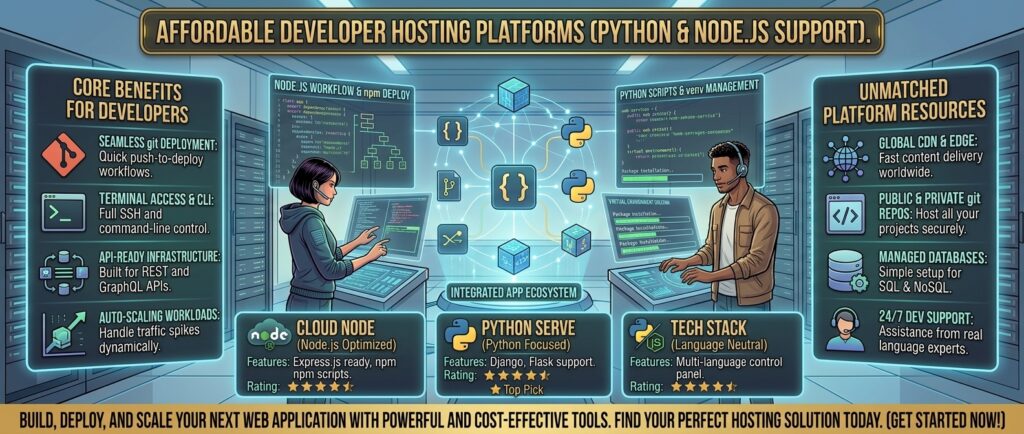
Best cheap web hosting services with python and node js support. Developing and deploying modern web applications no longer means relying solely on static HTML or standard PHP content management systems. For software engineers, full-stack developers, startups, and digital agencies building applications across dynamic commercial hubs like Texas, New York, California, Washington, and San Francisco, having native backend support for scripting languages like Python and Node.js is an absolute necessity.
Traditionally, running custom Node.js backend processes or Python web frameworks (such as Django, Flask, or FastAPI) required expensive, unmanaged virtual private servers (VPS) or cloud instances demanding complex command-line configuration. Today, however, leading budget-friendly web hosting providers incorporate user-friendly Python and Node.js selector tools directly into shared and cloud environments.
This comprehensive masterclass review guide analyzes the best cheap web hosting services featuring robust Python and Node.js support, breaking down their runtime options, command-line interfaces, server speeds, and overall value.
Why Modern Web Hosts Need Python and Node.js Support
Before exploring specific hosting platforms, let’s examine why access to Python and Node.js execution environments on budget hosting tiers is changing the game:
- Full-Stack Versatility: Node.js allows asynchronous, event-driven JavaScript backend execution, while Python powers powerful data analytics, machine learning scripts, and robust web APIs. Having both available under a single low-cost account streamlines project management.
- CloudLinux Application Selectors: Modern budget hosts utilize CloudLinux extensions (such as
Passengerand Python/Node.js application selectors) that let you configure app roots, startup files, and environment variables visually without touching complex server core files. - Cost Efficiency for Startups: Instead of paying $20 to $50 a month for dedicated developer environments right out of the gate, you can leverage budget-friendly shared and cloud hosting plans starting under $5 a month.
Top 5 Cheap Web Hosting Providers with Python & Node.js Support
1. Hostinger — Best Overall Budget Value with Developer Runtimes
Hostinger has established itself as an industry leader by pairing high-performance LiteSpeed infrastructure with versatile backend support for modern coding languages.
- Language Support: Full built-in support for Node.js and Python applications via custom dashboard utilities and secure SSH terminal access.
- Performance & Speed: Powered by NVMe SSD storage arrays and LiteSpeed caching, ensuring rapid execution and response times for dynamic applications.
- Key Features: Custom
hPanelmanagement interface, browser-based terminal, automated backups, and free SSL certificates. - Pros: Incredibly affordable introductory pricing; sleek, beginner-friendly interface; reliable domestic server nodes.
- Cons: Advanced configuration workflows differ from traditional cPanel setups.
2. Hosting.com (formerly A2 Hosting) — High-Speed Developer Environments
Hosting.com is renowned for its high-speed “Turbo” servers and robust developer toolkits, making it a favorite for running resource-intensive Python and Node.js scripts.
- Language Support: Comprehensive CloudLinux multi-version selectors for Python, Node.js, Ruby, and PHP, allowing granular version pinning.
- Performance & Speed: Turbo server plans use advanced caching layers and NVMe drives to maximize execution speed and lower latency.
- Key Features: Full SSH access, Git integration for automated code deployments, free account migrations, and enhanced security shielding.
- Pros: Exceptional server speeds; deep developer tool integration; reliable uptime.
- Cons: Maximum speed enhancements require upgrading to higher-tier Turbo plans.
3. ScalaHosting — Secure SPanel Cloud and Shared Python Environments
ScalaHosting provides innovative, secure hosting architectures tailored for developers who demand robust resource isolation and full control over their script runtimes.
- Language Support: Native support for Python, Node.js, and other modern runtimes via their proprietary
SPanelor cPanel management platforms. - Performance & Speed: Fully dedicated NVMe storage options and optimized database connectors ensure smooth backend processing.
- Key Features: Proprietary
SShieldcybersecurity AI, free website migrations, dedicated IP options, and staging environments. - Pros: Outstanding security isolation; versatile control panels; stellar technical support.
- Cons: Custom control panel ecosystem has a minor learning curve for developers used strictly to legacy layouts.
4. HostArmada — Feature-Rich Cloud Hosting with Full Node.js and Python Stacks
HostArmada delivers advanced cloud-backed hosting platforms equipped with complete development suites and automated management tools.
- Language Support: Pre-configured environments supporting Node.js, Python, and Ruby projects out of the box on both shared cloud and VPS tiers.
- Performance & Speed: 100% NVMe-backed cloud storage pools distributed across redundant server clusters for maximum fault tolerance.
- Key Features: Free daily backups, automated malware removal, Web Application Firewall (WAF), and cPanel access.
- Pros: All-inclusive security features; rapid customer support response; robust cloud stability.
- Cons: Renewal pricing scales up after the initial promotional term expires.
5. IONOS — Lowest Entry Cost for Unmanaged Developer VPS Hosting
IONOS is a veteran web provider known for offering aggressive pricing models, making it ideal for developers seeking unmanaged or semi-managed flexibility.
- Language Support: Full root access on VPS plans allows complete freedom to install custom Node.js, Python, and database binaries via command line.
- Performance & Speed: Solid geo-redundant data center routing and scalable resource allocations protect applications from unexpected traffic drops.
- Key Features: Wildcard SSL, custom business email included, daily backups, and snapshot management.
- Pros: Unbeatable entry pricing; complete root control for custom developer stacks; reliable hardware.
- Cons: Unmanaged environments require strong Linux system administration skills.
Comparative Matrix: Python & Node.js Budget Web Hosts
| Hosting Provider | Node.js Support? | Python Support? | SSH / Terminal Access | Starting Price |
| Hostinger | Yes | Yes | Yes (Web Terminal) | $2.49 / mo |
| Hosting.com | Yes | Yes | Full SSH Access | $1.99 / mo |
| ScalaHosting | Yes | Yes | Full SSH Access | $2.95 / mo |
| HostArmada | Yes | Yes | Full SSH Access | $2.49 / mo |
| IONOS | Yes (Root) | Yes (Root) | Full Root SSH | $1.00 / mo |
Best Practices for Deploying Python and Node.js on Cheap Hosting
Deploying custom backend applications on budget-friendly hosting requires careful resource management. Follow these professional tips to ensure stability:
- Use Application Managers (Passenger): Always configure your Node.js (
app.js/server.js) or Python (wsgi.py/asgi.py) applications through your host’s built-in application manager. This ensures the server automatically restarts your script if it crashes or reboots. - Monitor Memory Limits: Python and Node.js apps can consume significant RAM during heavy package installations (
npm installorpip install). Keep an eye on your account’s memory limits to avoid fatal out-of-memory errors. - Secure Your Environment Variables: Never hardcode sensitive API keys, database credentials, or secret tokens directly into your script repository. Utilize
.envfiles and restrict file permissions (chmod 600) via your file manager or SSH terminal. - Leverage Process Managers (PM2): If your host grants you full SSH and VPS access, utilize process managers like PM2 to keep your Node.js processes running continuously in the background.
Frequently Asked Questions (FAQ)
1. Can I run Python and Node.js on cheap shared hosting plans?
Yes. Many modern budget hosts (like Hostinger and Hosting.com) provide built-in Python and Node.js application selectors directly inside shared and cloud hosting control panels.
2. Do I need root access to run a Node.js application?
Not necessarily. Shared hosting plans with CloudLinux application managers allow you to deploy and run Node.js apps without needing root server privileges.
3. How do I install dependencies like npm packages or pip modules?
You can install dependencies either through your control panel’s application setup interface or by logging into your account via SSH and running npm install or pip install -r requirements.txt.
4. Will running custom backend scripts slow down my website?
If your scripts consume excessive CPU or RAM beyond your hosting plan’s allocated threshold, it can impact performance. Monitoring resource usage prevents bottlenecks.
5. What is the difference between shared Python/Node hosting and a VPS?
Shared hosting isolates your app within a constrained user environment managed by the host, whereas a VPS gives you a dedicated virtual server with total control over system binaries and OS configuration.
6. Can I host a React/Next.js frontend alongside a Node.js backend?
Yes. You can serve production builds of frontend frameworks or run full-stack Express/Next.js servers as long as your hosting environment supports the required Node version runtime.
7. How do I point a domain name to my Node.js application?
You map your domain name to your hosting account via DNS records, and then configure your host’s application manager to bind that specific domain or subdomain to your app’s root directory.
8. Are free SSL certificates compatible with custom Python/Node apps?
Yes. You can secure your custom backend applications with free Let’s Encrypt SSL certificates provided by your web host.
9. What should I do if my Python or Node app returns a 503 Service Unavailable error?
A 503 error usually means your application script has crashed or failed to bind to the assigned port. Check your host’s application error logs or stderr logs to pinpoint the syntax or configuration bug.
10. Which cheap web host is the best overall for Python and Node.js?
For an exceptional balance of user-friendly application selectors, high-speed NVMe hardware, and affordable pricing, Hostinger is the top overall recommendation—while Hosting.com and ScalaHosting lead for advanced developer toolkits.
Conclusion
Building modern web applications powered by dynamic backend scripts no longer requires an expensive enterprise budget. By partnering with a cost-effective web hosting provider offering robust Python and Node.js support—such as Hostinger, Hosting.com, ScalaHosting, HostArmada, or IONOS—developers, startups, and digital entrepreneurs operating across major commercial centers like Texas, New York, California, Washington, and San Francisco can deploy scalable, high-performance applications efficiently while keeping infrastructure costs low.