

When building, scaling, or auditing high-traffic digital infrastructure for target audiences across competitive tech hubs like Texas, New York, California, Washington, and San Francisco, database efficiency is everything. For data-intensive websites—such as WooCommerce retail empires, multi-vendor marketplaces, high-volume news publications, and real-time social platforms—the traditional relational database management system (RDBMS) like MySQL, PostgreSQL, or MariaDB is often the primary bottleneck.
As concurrent users flood your platform, executing complex relational database queries (JOIN operations, table lookups, and metadata filtering) consumes immense CPU cycles and disk I/O bandwidth. To keep Time to First Byte (TTFB) low and pass Google Core Web Vitals, web architects deploy high-speed, in-memory caching layers.
The two industry titans dominating this space are Memcached and Redis. But when your platform is strictly database-heavy, which tool delivers superior performance?
This comprehensive, expert-level architectural guide compares Memcached and Redis under heavy database load, exploring their underlying memory management models, execution threading, performance metrics, and configuration tips to help you maximize your site speed and Google search visibility.
1. Understanding the Database-Heavy Bottleneck
Before evaluating the caching engines, it is vital to understand why database-heavy sites struggle under load.
The Anatomy of a Database-Heavy Request
On a standard dynamic CMS (like WordPress, Drupal, or Magento), every un-cached page request triggers a waterfall of database transactions:
- Core Application Bootstrap: Loading framework configurations and user settings.
- User Session Authentication: Querying database tables to verify whether the visitor is logged in, what role they hold, and what permissions apply.
- Dynamic Content Assembly: Fetching custom post types, taxonomy terms, metadata blobs, and comment threads via complex SQL queries.
- E-Commerce Calculations: Pulling live inventory quantities, dynamic product variations, and tax rates.
When thousands of users hit these queries concurrently, physical storage subsystems (even high-speed NVMe SSDs) experience queuing delays. In-memory data stores solve this by intercepting these repetitive queries and serving pre-computed data straight from RAM.
2. Memcached: The Multi-Threaded Speed Veteran
Released in 2003, Memcached was designed with a singular, laser-focused philosophy: simplicity and raw, unadulterated speed for key-value caching.
Core Architectural Characteristics of Memcached:
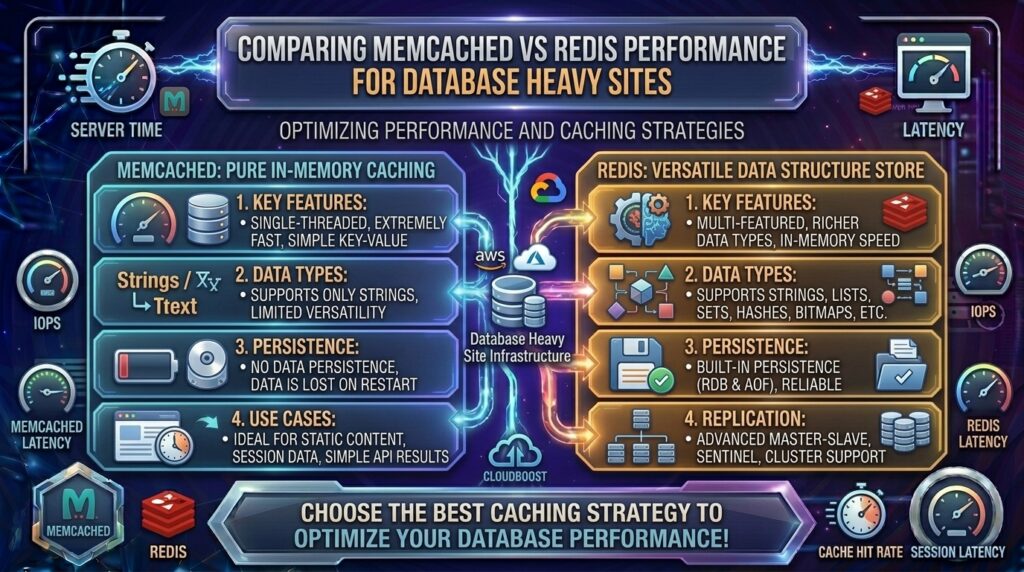
- Multi-Threaded Execution Model: Unlike older caching tools, Memcached is natively multi-threaded. It utilizes a locking mechanism across its execution threads, allowing it to horizontally scale and leverage multiple CPU cores on a single physical host machine.
- Strictly Key-Value (Strings Only): Memcached handles simple string-based key-value pairs (maximum value size is typically restricted to 1MB). It does not understand complex data structures, lists, or nested database relationships.
- Slab Allocator Memory Management: To prevent memory fragmentation, Memcached pre-allocates RAM into fixed-size chunks called “slabs”. While this keeps operations lightning fast over long periods, it can lead to minor memory waste if data objects do not fit neatly into pre-defined slab sizes.
- No Persistence: Memcached is entirely volatile. If the server restarts or memory exhausts, cached data disappears completely.
3. Redis: The Advanced Data Structure Server
Released in 2009, Redis (Remote Dictionary Server) revolutionized in-memory data storage by functioning not just as a simple cache, but as an advanced data structure server.
Core Architectural Characteristics of Redis:
- Single-Threaded Command Loop (with I/O Threads): Redis processes core command execution within a single-threaded event loop. While this might sound restrictive, it guarantees absolute atomicity for every operation, entirely eliminating race conditions, deadlocks, and complex locking overhead.
- Rich Data Structures: Unlike Memcached’s plain strings, Redis natively supports Hashes, Lists, Sets, Sorted Sets, Bitmaps, and Streams. For database-heavy sites, this is a massive advantage: you can cache individual fields of a database record inside a Redis Hash without fetching and rewriting the entire data blob.
- Flexible Memory Allocation: Redis uses dynamic memory allocation (
jemalloc), allowing individual data objects to scale up to 512MB. Furthermore, Redis efficiently reclaims memory when keys expire or are flushed, unlike Memcached which holds onto pre-allocated memory chunks. - Built-in Persistence: Redis supports point-in-time disk snapshots (RDB) and Append-Only File (AOF) journals, allowing cache states to survive server reboots and deployments.
4. Head-to-Head Performance Comparison for Database-Heavy Sites
When putting both systems through heavy relational database stress tests, distinct performance patterns emerge:
| Performance Metric | Memcached | Redis | Winner |
| CPU Core Utilization | Multi-threaded (utilizes all available CPU cores natively) | Single-threaded command loop (with async I/O threads) | Memcached (on massive multi-core hardware) |
| Query Complexity Handling | Basic string blobs only (requires app-side serialization/parsing) | Native support for hashes, sets, and sorted sets | Redis (reduces network payload sizes) |
| Memory Efficiency | Fixed slab allocation can lead to internal fragmentation | Dynamic allocation; reclaims purged memory effectively | Redis |
| Data Durability | None (volatile RAM only) | RDB snapshots and AOF persistence options | Redis |
| Raw Read/Write Throughput | Exceptionally high for uniform, small string reads | Extremely high, though write times vary with complex structures | Tie / Workload Dependent |
5. Why Redis Usually Wins for Complex CMS and E-Commerce Workloads
While Memcached can boast a slight edge in raw multi-threaded throughput for uniform string caching, Redis is almost universally the superior choice for database-heavy sites due to specific structural advantages:
1. Granular Field Updates via Hashes
Imagine a database record containing user metadata or product settings with 50 individual fields.
- With Memcached, if a single field changes, your application must fetch the entire serialized string object from cache, deserialize it, update the field, re-serialize it, and push the entire blob back into memory.
- With Redis Hashes, your application can target and update just that single field inside the hash structure (
HSET), saving substantial network bandwidth and CPU cycles.
2. Eliminating Database Lockups with Object Caching Plugins
For WordPress and WooCommerce sites handling heavy transactions, advanced object caching plugins (such as Object Cache Pro) leverage Redis to cache native database queries, term relationships, and user sessions. Redis handles these complex caching groups smoothly without bloating server memory tables.
6. Configuring Your Hosting Stack for Maximum Cache Performance
Whether you choose Memcached or Redis, your hosting infrastructure configuration dictates how effectively your cache performs under heavy database strain.
1. Bind to Local UNIX Sockets
Instead of communicating over TCP network ports (127.0.0.1:6379), configure your caching daemon to communicate via local UNIX sockets (/var/run/redis/redis.sock). This bypasses the operating system’s network stack entirely, slashing communication latency between your application and the cache layer.
2. Establish Strict Memory Limits (maxmemory)
Always configure an explicit memory ceiling on your hosting instance. For example, if your cloud server has 8GB of RAM, allocate 2GB to 4GB exclusively to Redis or Memcached, and set an appropriate eviction policy (allkeys-lru) to automatically purge stale database cache queries when limits are reached.
7. How Caching Directly Drives Google SEO & Core Web Vitals
Database-heavy websites frequently suffer from high Time to First Byte (TTFB) because backend queries delay server response generation. Implementing a robust in-memory caching layer directly impacts search rankings:
- Instant TTFB Acceleration: Shifting database queries into RAM drops server processing times from hundreds of milliseconds down to under 20 milliseconds, easily satisfying Google’s 800ms TTFB threshold.
- Passes Largest Contentful Paint (LCP): When database bottlenecks disappear, server resources remain unconstrained, enabling faster document delivery and rendering of hero images and primary content blocks.
- Preserves Crawl Budget: Search engine crawlers can index thousands of deep product pages or archival records per session without timing out or triggering database connection errors (
504 Gateway Timeout).
8. Frequently Asked Questions (FAQ)
1. What is the core difference between Memcached and Redis for database-heavy sites?
Memcached is a multi-threaded, string-only key-value store built for simple, raw speed. Redis is an advanced data structure server supporting complex data types (hashes, lists, sets) and data persistence, making it ideal for relational database offloading.
2. Which caching system is better for WooCommerce and e-commerce stores?
Redis is universally preferred for e-commerce platforms because its advanced data structures and hash-mapping capabilities handle dynamic user sessions, shopping carts, and inventory queries more efficiently than simple string blobs.
3. Does Memcached perform better than Redis under high concurrent read loads?
Memcached’s multi-threaded architecture can give it a slight raw throughput edge for simple, uniform string reads across multi-core CPUs. However, Redis performance is more than fast enough for sub-millisecond responses in almost all web scenarios.
4. Can Memcached store complex database objects?
Not natively. Memcached only accepts string payloads. Applications must serialize complex relational database arrays into strings before storing them, and deserialize them upon retrieval.
5. Does Redis consume more memory than Memcached?
Historically, Redis required slightly more memory overhead for complex structures, but its dynamic memory allocator (jemalloc) handles memory reclamation much better than Memcached, which permanently holds pre-allocated slab memory chunks.
6. What happens to cached database data if the server crashes?
With Memcached, all data is lost instantly because it lacks persistence. With Redis, you can configure RDB snapshots or AOF logs to persist data, allowing cache states to survive reboots.
7. How do I choose between them on a managed cloud hosting server?
If your application requires basic full-page or simple fragment caching, either will work. If your application handles complex relational database queries, user session tracking, or rate limiting, choose Redis.
8. Can I run Memcached and Redis simultaneously on the same server?
Yes, though it is rarely necessary. Some enterprise environments use Memcached for simple stateless full-page caching blocks while utilizing Redis as a primary database object cache and session store.
9. How does object caching impact Google Core Web Vitals?
By eliminating database query delays, object caching drastically lowers your Time to First Byte (TTFB), which serves as the foundational metric for achieving a passing LCP (Largest Contentful Paint) score.
10. When should I upgrade my server hardware for my caching layer?
If monitoring tools show your cache hit ratio falling below 90% or indicate that your maxmemory limit is constantly evicting active keys, your caching tier has outgrown its current RAM allocation and requires a cloud resource upgrade.
9. Conclusion
When evaluating Memcached vs Redis performance for database-heavy sites, both tools provide blistering, sub-millisecond in-memory speeds. However, Redis emerges as the definitive champion for modern, dynamic applications and e-commerce platforms due to its versatile data structures, hash-level field updates, dynamic memory management, and built-in persistence options.