

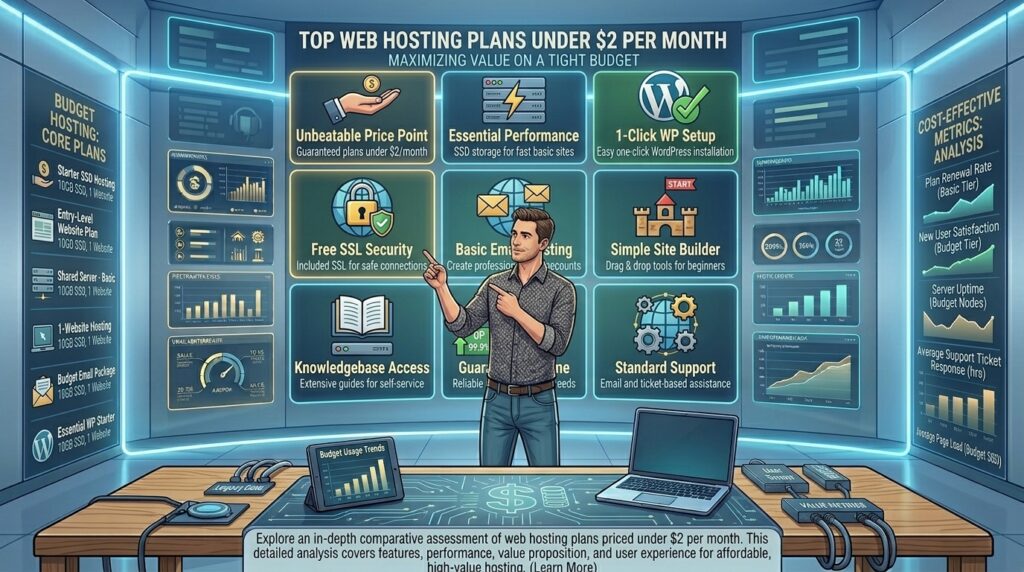
Best web hosting under 2 dollars per month: When launching a new digital venture—whether you are deploying a boutique portfolio in San Francisco, an e-commerce landing page in New York, a consulting startup in Texas, a tech blog in Washington, or a creative site in California—minimizing initial overhead is a top priority. For bootstrapping entrepreneurs, finding the best web hosting under 2 dollars per month sounds like the ultimate financial win.
However, ultra-cheap hosting comes with a notorious reputation: frequent downtime, sluggish server response times, hidden renewal rate traps, and minimal security protections. But as hardware efficiencies have matured globally, several budget-tier web hosting providers have optimized their infrastructure to deliver surprisingly robust performance without breaking the bank.
In this exhaustive, highly informative analysis and guide, we investigate the reality of sub-$2-per-month web hosting, evaluate how these plans impact Google SEO performance, break down the fine print, and highlight the absolute best providers available for cost-conscious creators.
The Reality of Sub-$2 Hosting: What’s the Catch?
Before hunting for ultra-cheap hosting plans, it is vital to understand how providers achieve sub-$2 pricing models and what compromises you can expect.
+-------------------------------------------------------------+
|               The Mechanics of Sub-$2 Hosting               |
+-------------------------------------------------------------+
|  [Long-Term Commitments] --> Usually requires 1-to-3 yr prepay|
|  [Introductory Rates]    --> Sharp price jumps upon renewal |
|  [Resource Caps]         --> Stricter inode & CPU throttling|
|  [Server Densities]      --> High volume of sites per node  |
+-------------------------------------------------------------+
1. The Multi-Year Commitment Trap
You will almost never find a month-to-month web hosting plan priced under $2. To secure that monthly average, providers require you to pre-pay for an upfront multi-year term (typically 12, 24, or 36 months).
2. High Renewal Spikes
The advertised $1.88 or $1.98 monthly price is almost always an introductory hook. When your initial term expires, standard renewal rates typically jump to $5, $8, or even $15+ per month.
3. Resource Limitations and Densities
At under $2 a month, you are placed on a shared hosting server crowded with hundreds of other accounts. If a neighboring site experiences a traffic surge or runs unoptimized code, your site’s performance can experience temporary lag.
Top Providers Offering Hosting Around or Under $2/Month
While true sub-$2 plans fluctuate due to ongoing market promotions, a select group of reputable registrars and hosting companies consistently hover near this ultra-budget threshold.
1. Namecheap (Stellar Plan)
- Approximate Introductory Price: ~$1.88 to $2.28 per month (on multi-year terms).
- Storage Allocation: 20 GB SSD.
- Key Inclusions: Hosts up to 3 websites, unmetered bandwidth, free auto-backup tools on higher tiers, and a free domain name for the first year.
- Verdict: One of the most stable and trusted names in the budget tier, providing clean cPanel integration and reliable uptime.
2. OVHcloud (Starter Plan)
- Approximate Introductory Price: ~$1.89 per month.
- Storage Allocation: 1 GB to start (focused on lean starter sites).
- Key Inclusions: 1 free domain name for the first year, Let’s Encrypt SSL, and automated daily backups with a 14-day restoration window.
- Verdict: Best suited for basic, low-traffic single-page websites or personal blogs where advanced database resource demands are minimal.
3. AccuWeb Hosting (Budget / WordPress Entry Plans)
- Approximate Introductory Price: Often features promotional tiers starting around $2.00/mo on long-term contracts.
- Key Inclusions: Generous features relative to price, custom firewalls, and malware scanning.
- Verdict: Highly regarded for providing a solid security baseline even on budget plans.
SEO Impact: Can Sub-$2 Hosting Rank on Google?
Search engine optimization relies heavily on technical performance metrics, particularly Google’s Core Web Vitals. Choosing an ultra-cheap host introduces specific SEO challenges and solutions:
- Time to First Byte (TTFB) Risks: Budget shared servers can exhibit higher latency if overloaded. A high TTFB delays Largest Contentful Paint (LCP), which can hurt your organic search rankings.
- Uptime Consistency: Search engine bots (Googlebot) penalize sites that frequently return server timeout errors. Reliable uptime is non-negotiable, even on cheap plans.
- Mitigating SEO Risks via CDNs: You can easily neutralize the hardware limitations of a $2 host by pairing your site with a free Content Delivery Network (CDN) like Cloudflare. Edge caching serves your static assets globally, bypassing the budget host’s origin server for most visitors.
Pros and Cons of Sub-$2 Web Hosting
The Pros 👍
- Unbeatable Cost Efficiency: Perfect for testing new business ideas, hobby sites, or student portfolios without financial risk.
- Essential Inclusions: Most reputable budget plans still bundle free SSL certificates and basic site builders.
- Low Barrier to Entry: Allows webmasters to secure domain and hosting configurations for minimal upfront capital.
The Cons 👎
- Stricter Inode and Storage Caps: Low-cost plans limit file counts and database sizes, restricting long-term site growth.
- Higher Renewal Margins: Initial savings disappear once the introductory promotional contract concludes.
- Basic Support Channels: Live chat response times on ultra-budget tiers can occasionally involve longer queues during peak support hours.
10 Essential Tips to Maximize Performance on Ultra-Cheap Hosting
- Leverage Cloudflare CDN: Route your DNS through Cloudflare to cache static assets at edge locations, protecting your budget server from traffic spikes.
- Install Lightweight Caching Plugins: Use optimized caching tools to store static page outputs in memory and reduce database query loads.
- Optimize All Media Assets: Compress JPEGs, PNGs, and GIFs into WebP or AVIF formats to conserve your limited storage allocation.
- Select the Closest Data Center Node: If your audience is concentrated in US tech hubs (New York, Texas, California, Washington, or San Francisco), pick a North American server node during checkout.
- Clean Database Bloat Regularly: Purge post revisions, spam comments, and transient cache tables from your MySQL databases frequently.
- Audit Plugins Ruthlessly: Avoid resource-heavy plugins or poorly coded page builders that trigger server memory exhaustion errors.
- Keep PHP Updated: Run your sites on the latest stable version of PHP (8.2 or 8.3) for maximum execution speed and lower CPU overhead.
- Set Up Independent Backups: Since budget plans may limit internal backup retention, configure offsite cloud backups to protect your data.
- Monitor Renewal Dates Closely: Keep track of your billing cycles so you are never caught off-guard by standard rate adjustments.
- Plan an Eventual Migration: Treat sub-$2 hosting as a launchpad; upgrade to a robust VPS or cloud instance once your site generates steady traffic and revenue.
Frequently Asked Questions (FAQ)
1. Is it really possible to find reliable web hosting for under $2 per month?
Yes, providers like Namecheap and OVHcloud offer introductory shared hosting plans that drop below $2 per month, provided you commit to an upfront multi-year billing term.
2. What is the catch with ultra-cheap web hosting plans?
The primary trade-offs include mandatory multi-year prepayments, steep price increases upon renewal, stricter storage caps, and shared server resource limits.
3. Will sub-$2 hosting slow down my website’s loading speed?
Budget shared servers can experience higher latency if neighboring sites consume excessive resources. However, you can offset this by using a fast caching plugin and a free CDN like Cloudflare.
4. Are free domain names included with sub-$2 hosting plans?
Some budget providers include a free domain name registration for the first year when you purchase annual or multi-year packages, though standard domain renewal rates apply afterward.
5. Can I run WordPress on a sub-$2 hosting plan?
Yes, nearly all budget shared hosting plans feature 1-click WordPress installers and support the necessary PHP and MySQL environments required to run WordPress smoothly.
6. Are free SSL certificates included to secure my site?
Yes, reputable budget hosts include free Let’s Encrypt SSL certificates across their plans to ensure HTTPS encryption and satisfy Google’s security requirements.
7. How do renewal rates compare to introductory sub-$2 prices?
Introductory rates are heavily discounted promotional hooks. When your initial term ends, renewal pricing typically adjusts to standard market rates ranging from $5 to $12+ per month.
8. Is sub-$2 hosting suitable for high-traffic e-commerce stores?
No. High-traffic e-commerce sites running WooCommerce or shopping carts require dedicated resources, high RAM allocations, and robust database processing power found on VPS or cloud plans.
9. How many visitors can a sub-$2 shared hosting plan handle?
Most entry-level shared hosting plans comfortably handle small personal blogs or static portfolio sites receiving up to a few thousand monthly visitors.
10. What should I do when my website outgrows a budget hosting plan?
When your site experiences increased traffic, slower response times, or hits server resource limits, you should seamlessly migrate your files to an NVMe VPS or managed cloud hosting tier.
Conclusion
Finding the best web hosting under 2 dollars per month is entirely achievable for webmasters launching lean projects, personal portfolios, or startup blogs. While sub-$2 plans require multi-year commitments and careful resource management, providers like Namecheap and OVHcloud offer reliable foundational entry points.
By pairing ultra-cheap hosting with smart optimizations like Cloudflare CDNs and compressed media assets, digital entrepreneurs across Texas, New York, California, Washington, and San Francisco can successfully build functional web presences on a shoestring budget before scaling up to high-performance infrastructure.