

Linode vs AWS lightsail for small business websites: The Ultimate Small Business Cloud Server Guide
Linode vs AWS lightsail for small business websites: For small business owners, web developers, and digital agencies building out web applications across major metropolitan hubs—from New York and San Francisco to Seattle (Washington), Austin (Texas), and Los Angeles (California)—shared web hosting quickly hits a brick wall. When your platform experiences traffic surges, dynamic e-commerce transactions, or heavy database queries, standard shared servers buckle under the load.
The modern solution is transitioning to lightweight, scalable cloud infrastructure. Two industry stalwarts dominate this tier: Linode (now part of the Akamai Connected Cloud) and AWS Lightsail. Both providers offer simplified Virtual Private Servers (VPS) designed to bypass the daunting complexity of full-scale enterprise clouds like AWS EC2 or Google Cloud.
This comprehensive, highly detailed comparison evaluates performance, true cost transparency, developer ecosystems, and scalability to help you choose the ideal cloud server platform for your small business website.
1. Introduction: Understanding the Philosophy
Linode (Akamai Connected Cloud): The Developer’s Favorite Independent Cloud
Founded in 2003 and later acquired by edge giant Akamai, Linode built its legendary reputation on transparency, developer freedom, raw performance, and predictable, flat-rate pricing. Now operating as part of the Akamai Connected Cloud, Linode bridges the gap between commodity infrastructure and high-performance distributed edge networking. It offers unfettered root access, powerful NVMe storage arrays, and a complete lack of artificial software restrictions.
AWS Lightsail: The Entry Portal to the Amazon Ecosystem
AWS Lightsail was created by Amazon Web Services to capture small-to-medium businesses intimidated by the steep learning curve and billing unpredictability of core AWS (EC2, S3, IAM). Lightsail bundles compute, SSD storage, and generous data transfer into predictable flat-rate monthly packages. Its primary advantage is acting as an easy on-ramp to the massive, sprawling ecosystem of enterprise AWS web services.
2. Core Architecture, Hardware, and Performance
When your business relies on swift page load times to maintain high Google SEO rankings and maximize e-commerce conversions, the underlying hardware makes all the difference.
+-----------------------------------+-----------------------------------+
|              LINODE               |           AWS LIGHTSAIL           |
+-----------------------------------+-----------------------------------+
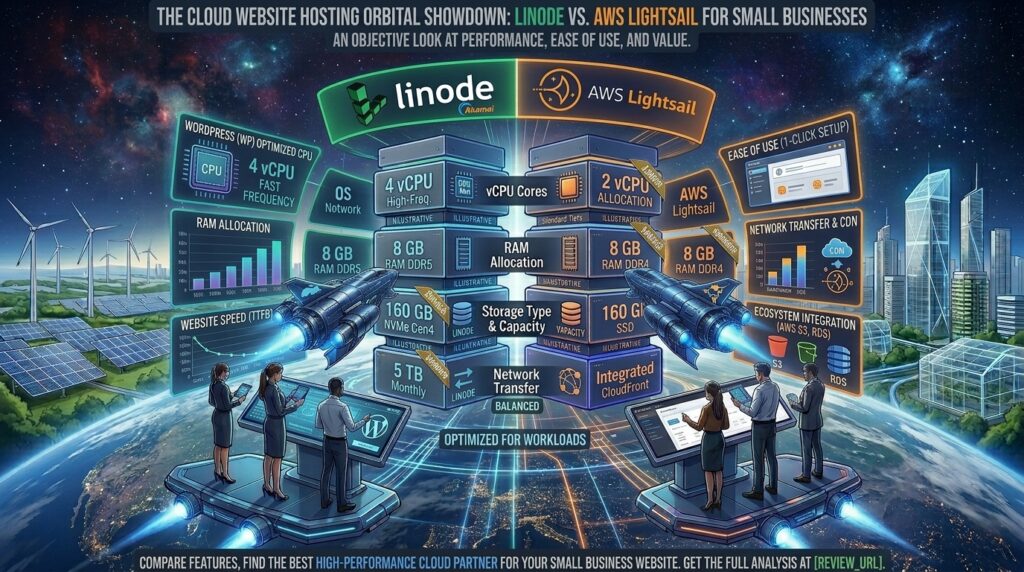
| • 100% Native NVMe SSD Storage    | • Standard Block SSD Storage      |
| • Shared & Dedicated CPU Tiers    | • Burstable CPU Performance Model |
| • Transparent Hourly/Monthly Caps | • Bundled Monthly Transfer Quotas |
| • Akamai Global Edge Integration  | • Seamless Native AWS Integration |
+-----------------------------------+-----------------------------------+
CPU Performance Models
- Linode: Offers clear structural choices between Shared CPU instances (ideal for blogs, staging sites, and light apps) and Dedicated CPU instances (engineered for heavy databases, SaaS platforms, and high-concurrency WooCommerce stores). Linode’s processors deliver consistent, unthrottled computing power.
- AWS Lightsail: Relies primarily on a burstable performance baseline for its standard instances. While cost-effective, these instances accumulate CPU “credits” during low-traffic intervals to expend during traffic spikes. If your small business site handles sustained, heavy computational tasks, a burstable instance can throttle performance once your credit balance depletes.
Storage & Disk I/O
- Linode: Standardizes on high-performance NVMe SSD storage across its modern compute plans, yielding exceptionally fast read/write speeds that minimize database query latency.
- AWS Lightsail: Utilizes standard SSD-backed block storage volumes bundled into each instance tier. While adequate for general web traffic, raw input/output operations per second (IOPS) trail behind native NVMe configurations.
3. Pricing Structures and True Cost Transparency
Predictable budgeting is vital for small businesses. While both platforms advertise attractive entry prices, looking closely at how they bill for auxiliary resources reveals important differences.
Linode’s Straightforward Billing
Linode’s pricing model is legendary for its simplicity:
- Flat hourly and monthly caps.
- Generous outbound data transfer allowances included natively with every tier.
- No hidden fees or surprise egress charges for standard traffic pools.
AWS Lightsail’s Hidden TCO Factors
While Lightsail’s base monthly bundles look clean on paper (e.g., $5 to $24 per month), expanding your production stack can introduce unexpected costs:
- Storage and Snapshots: Automatic snapshots and additional block storage volumes accrue separate per-gigabyte monthly fees.
- Data Transfer Overages: Exceeding your bundled monthly transfer quota results in rigid overage billing rates depending on your AWS region.
- The “Stop” Charge Misconception: Unlike traditional cloud VMs where stopping an instance halts compute billing, certain AWS resource associations and static IP allocations can continue to tick minor charges unless managed carefully.
4. Global Datacenter Footprints & US Latency
Geographic proximity dictates network latency. For small businesses targeting localized customer bases across commercial hubs—such as New York, San Francisco, Seattle, Austin, or Los Angeles—routing efficiency directly dictates user experience.
- Linode (Akamai Connected Cloud): Features a robust global network of core data centers. Linode’s domestic US nodes (covering Newark/New York, Atlanta, Dallas, Chicago, Fremont/San Francisco, and Seattle) allow you to place your web application within milliseconds of your target audience. Furthermore, its integration with Akamai brings edge caching and enterprise-grade DDoS mitigation directly to smaller applications.
- AWS Lightsail: Inherits AWS’s massive, world-class infrastructure network spanning 19+ global regions. US coverage is exceptionally dense, with localized availability zones in Northern Virginia, Ohio, Oregon, and Northern California, ensuring ultra-low latency routing for coast-to-coast American traffic.
5. Developer Ecosystems and Scaling Pathways
A small business website rarely stays the same size. Your hosting infrastructure must accommodate future growth.
+-----------------------------------------------------------------------+
|                       SCALING TRAJECTORIES                            |
+-----------------------------------------------------------------------+
| • Linode: Scale smoothly from a single Nanode to multi-node           |
|           Kubernetes clusters (LKE) and managed MySQL/PostgreSQL.      |
| • AWS Lightsail: Easily "detach" or upgrade a Lightsail instance and  |
|                  migrate directly into core enterprise AWS (EC2/RDS). |
+-----------------------------------------------------------------------+
Linode’s Ecosystem
Linode provides robust, developer-first tools including the Linode Kubernetes Engine (LKE), managed databases, object storage, and Cloud Firewall management. Moving from a single virtual server to a load-balanced cluster is straightforward and cost-effective.
AWS Lightsail’s Ecosystem
Lightsail serves as the ultimate gateway drug to the Amazon cloud. If your small business eventually outgrows a simple VPS, Lightsail allows you to “export” your instance snapshot and scale directly into enterprise AWS infrastructure (such as EC2, Relational Database Service, and S3 buckets) without rewriting your entire application stack.
6. Pros and Cons
Linode (Akamai Connected Cloud)
- Pros:
- 100% NVMe storage arrays delivering blistering database performance.
- Predictable, transparent flat-rate pricing with zero hidden egress traps.
- Dedicated CPU tiers available for high-performance workloads.
- Akamai edge integration for advanced security and content delivery.
- Cons:
- Lacks an immediate, native upgrade path into a proprietary multi-service ecosystem like AWS.
- Support SLAs require higher tiers for rapid phone/chat escalations.
AWS Lightsail
- Pros:
- Backed by the immense global reliability and redundancy of Amazon Web Services.
- Seamless scaling path into core enterprise AWS services (EC2, RDS).
- Simple, pre-configured application stacks (WordPress, LAMP, Node.js, Magento).
- Predictable flat-rate monthly bundles for basic setups.
- Cons:
- Burstable CPU baseline can throttle sustained high-traffic workloads.
- Supplementary features (snapshots, extra storage, static IPs) can inflate your bill.
- Steeper learning curve when navigating the broader AWS billing console.
7. Expert SEO & Hosting Tips for Small Business Owners
If your small business website targets competitive US markets (New York, California, Texas, Washington), apply these expert strategies to optimize your cloud deployment:
- Choose Dedicated CPU for E-Commerce: If you run an online store processing live checkouts or user logins, bypass shared/burstable instances and invest in Linode’s Dedicated CPU plans to eliminate latency spikes.
- Deploy Regional Matching: Match your cloud server region directly to your primary customer demographic (e.g., Fremont or Oregon nodes for West Coast users; Newark or Virginia nodes for East Coast traffic).
- Implement Object Caching: Offload database overhead by installing Redis or Memcached locally to keep your Time to First Byte (TTFB) well under Google’s 200ms threshold.
- Automate External Backups: Never rely solely on local server snapshots. Maintain secondary off-site backups using S3-compatible object storage to protect business continuity.
8. Frequently Asked Questions (FAQ)
1. Which is better for a small business website, Linode or AWS Lightsail?
Linode generally offers better raw performance, 100% NVMe storage, and more transparent pricing. AWS Lightsail is better if your long-term roadmap requires deep integration with enterprise AWS services.
2. Do both providers offer pre-configured WordPress stacks?
Yes. Both Linode (via the Linode Marketplace) and AWS Lightsail allow you to launch pre-configured, one-click application images for WordPress, Magento, Node.js, and LAMP/LEMP stacks.
3. How do their CPU performance models differ?
Linode offers distinct choices between Shared and Dedicated CPU instances with unthrottled execution. AWS Lightsail relies on burstable performance instances that use CPU credits, which can throttle heavy sites during sustained traffic spikes.
4. Are there hidden fees with AWS Lightsail?
While base instance bundles have flat prices, auxiliary features like extra block storage, snapshot retention, static IP management, and data transfer overages are billed separately and can catch small business owners off guard.
5. Can I easily scale my server as my business grows?
Yes. Both platforms allow you to vertical-scale (resize your plan to add more RAM and CPU) with a simple reboot. Linode also supports horizontal scaling via load balancers and Kubernetes.
6. Which host provides better data center options in the US?
Both providers offer robust US coverage. AWS Lightsail leverages Amazon’s massive availability zone network, while Linode covers major commercial hubs from New Jersey and Atlanta to Texas and California.
7. Do I need advanced technical skills to manage these servers?
Yes, basic Linux system administration skills are required for both platforms since they provide root access. However, Lightsail offers a slightly more simplified management dashboard for absolute beginners.
8. How do their backup solutions compare?
Linode offers automated backup add-ons managed directly through its cloud manager. AWS Lightsail provides manual and automated snapshot scheduling, though retained snapshot histories accrue separate storage fees.
9. Which platform is better for SEO and page load speeds?
Linode’s inclusion of native NVMe drives and unthrottled dedicated CPU choices gives it a slight edge in generating faster server response times (TTFB), which directly benefits Google SEO performance.
10. Which provider offers superior long-term value for a small business?
For predictable budgeting, unthrottled performance, and transparent resource costs, Linode (Akamai Connected Cloud) delivers superior long-term value. If your company is already committed to the AWS corporate ecosystem, AWS Lightsail provides a convenient starting point.
9. Conclusion
When evaluating Linode vs. AWS Lightsail for small business websites, your decision hinges on your performance priorities and long-term tech stack strategy.
Choose Linode if your small business demands unthrottled computing power, 100% NVMe storage speeds, transparent pricing with zero surprise bills, and developer-friendly flexibility.
Choose AWS Lightsail if your organization plans to scale into enterprise-grade Amazon Web Services (AWS) in the future and you need a gentle, pre-configured entry portal into the AWS ecosystem.
Analyze your website’s resource demands, evaluate your growth trajectory, and deploy your business on the cloud infrastructure designed to rank at the top of Google search results.