

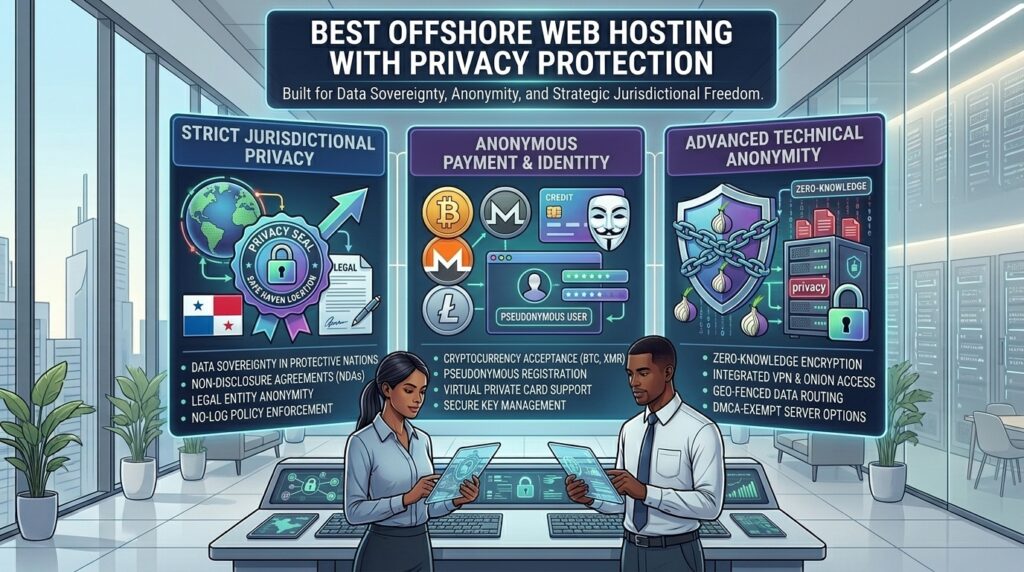
In an era defined by aggressive data harvesting, sweeping cross-border surveillance agreements, and aggressive legal overreach, safeguarding digital privacy has shifted from a luxury to an absolute necessity. Whether you are managing independent media outlets, confidential research portals, intellectual property databases, or commercial enterprises that demand strict data sovereignty across tech hubs like Texas, New York, California, Washington, and San Francisco, standard domestic hosting leaves your infrastructure vulnerable to local subpoenas and administrative overreach.
When you host a website domestically, your data is governed by local telecommunications and privacy laws—such as the USA PATRIOT Act or broad intelligence-sharing frameworks. Offshore web hosting relocates your physical server hardware and data to privacy-focused jurisdictions outside your home country, shielding your operations behind robust local constitutional protections and strict data privacy regulations.
This comprehensive, deeply informative guide explores the complexities of offshore web hosting, evaluates top-tier privacy-centric hosting providers, reviews key legislative jurisdictions, and outlines technical SEO strategies to keep your secure site visible and ranking high on Google.
1. Why Digital Privacy Demands Offshore Web Hosting Infrastructure
Many webmasters and privacy advocates assume that standard SSL encryption and a hidden WHOIS registration are enough to secure their online footprint. Unfortunately, domestic hosting exposes site owners to multiple systemic vulnerabilities:
- Jurisdictional Vulnerability and Subpoenas: Domestic hosts are legally compelled to comply with local court orders, data-handover demands, and administrative subpoenas. If a litigious entity or government agency targets your domain, local hosts must hand over server logs, database backups, and billing details without notifying you.
- The Reach of Intelligence Alliances: Countries tied into intelligence-sharing pacts—such as the Five Eyes, Nine Eyes, and Fourteen Eyes alliances—routinely share intercepted digital communications across borders. Moving your infrastructure to a non-aligned or strictly neutral jurisdiction creates a vital legal firewall.
- Copyright Notice Pressure (DMCA vs. Offshore Reality): Standard web hosts operating under US or EU jurisdiction must swiftly comply with Digital Millennium Copyright Act (DMCA) takedown notices. Legitimate independent review sites, critique blogs, and media platforms often face frivolous, automated copyright complaints meant to censor competition. Offshore or DMCA-ignored hosts operate in environments where foreign copyright notices carry no direct local legal force.
- Financial Anonymity and Alternative Gateways: True privacy hosting supports alternative payment methods—including cryptocurrencies (Bitcoin, Monero) and prepaid options—allowing you to provision servers without linking your personal credit card or banking records.
2. Core Legal Jurisdictions: Where Should Your Server Live?
When choosing offshore hosting, the hardware specifications are largely identical globally; the governing law of the physical server location is what matters most. The premier jurisdictions recognized for rigorous data protection include:
- Switzerland: Widely regarded as the gold standard for legal privacy. Operating entirely outside the European Union and all intelligence-sharing pacts, Switzerland enforces strict constitutional privacy protections and updated data privacy acts (revFADP). Foreign data requests must clear rigorous local Swiss court reviews.
- Iceland: Renowned for free speech advocacy, independent journalism protections, and data centers powered entirely by green, renewable geothermal energy. Iceland acts as a robust safe haven for publishing and freedom-of-information platforms.
- The Netherlands: A powerhouse digital connectivity hub featuring Amsterdam’s AMS-IX exchange. While bound by EU GDPR regulations (which offer strong consumer privacy rights against corporate tracking), Dutch hosting providers maintain a historically liberal, hands-off culture regarding content, provided it adheres to local criminal statutes.
- Panama: Positioned far outside US and EU legal frameworks. Panama features deep-rooted banking and data privacy traditions combined with strong resistance to foreign copyright and censorship frameworks.
3. Top Offshore Web Hosting Providers Ranked for Privacy and Security
Based on jurisdiction strength, anonymous payment options, hardware performance, and uptime reliability, here are the leading offshore hosting providers on the market:
A. Shinjiru (Best Long-Standing Provider for DMCA-Ignored & Offshore Protection)
Operating since 2000, Shinjiru is a pioneer in offshore hosting, offering dedicated privacy solutions across multiple anonymous data centers worldwide.
- Why it shines for Privacy: Shinjiru offers dedicated “Strongbolt” offshore privacy plans, complete anonymous registration options, acceptance of cryptocurrency payments, and specialized offshore server locations protected from aggressive foreign copyright claims.
- Best For: Publishers, privacy advocates, and webmasters seeking established offshore infrastructure with flexible anonymity controls.
- Pricing: Plans typically start around $3.95/month.
B. OrangeWebsite (Best Iceland-Based Green Privacy Hosting)
Based out of Reykjavik, Iceland, OrangeWebsite specializes in absolute freedom of speech, privacy-first hosting, and sustainable server operations.
- Why it shines for Privacy: Operating under Icelandic jurisdiction—renowned for stringent freedom of information laws—OrangeWebsite accepts Bitcoin and other privacy cryptocurrencies, requires minimal personal verification at signup, and runs on 100% green energy.
- Best For: Independent journalists, whistleblowing platforms, and privacy-conscious bloggers.
- Pricing: Plans start around €28+/month.
C. Hostinger (Best Budget-Friendly Offshore Provider with Global Reach)
While Hostinger is a mainstream global host, it operates multiple data center options across Europe and supports advanced privacy features like Cloudflare-integrated nameservers and domain WHOIS privacy protection.
- Why it shines for Privacy: For users who want affordable introductory pricing combined with reliable global performance and alternative payment methods, Hostinger provides a balanced entry point.
- Best For: Budget-conscious projects looking for reliable uptime without entering complex enterprise hosting tiers.
- Pricing: Introductory shared plans start around $2.69/month.
D. DotShift (Best Fast-Deploy Offshore cPanel Hosting)
DotShift provides high-speed offshore and DMCA-tolerant hosting plans equipped with modern management tooling.
- Why it shines for Privacy: Offers instant deployment, NVMe storage acceleration, LiteSpeed web server architecture, Imunify360 security shielding, and flexible offshore isolation designed to keep sites secure and online.
- Best For: Developers and site owners seeking standard cPanel familiarity coupled with offshore content flexibility.
- Pricing: Competitive entry-level pricing tiers.
4. Masterclass: Technical SEO and Performance Optimization for Offshore Sites
Hosting your website offshore in a privacy-friendly jurisdiction introduces unique technical hurdles, particularly regarding server latency and geographical distance from your core audience. Implement these expert strategies to maintain top Google search rankings:
Leveraging Global CDN Edge Routing (Cloudflare)
If your offshore server is located in Zurich, Iceland, or Panama, but your primary target audience spans New York, San Francisco, and London, direct physical connection latency can hurt your site speed.
- Route your domain through a global Content Delivery Network (CDN) like Cloudflare Enterprise or Free tiers.
- The CDN caches your static content, images, and scripts across hundreds of global edge data centers, delivering sub-second page loads to your visitors while masking your origin server’s true IP address.
Optimizing Core Web Vitals on Offshore Hardware
Google’s mobile-first algorithm penalizes slow server response times (Time to First Byte – TTFB). Ensure your offshore host utilizes:
- NVMe Solid-State Drives rather than legacy mechanical disks.
- LiteSpeed or Redis Caching to minimize database query latency.
- Automated WebP/AVIF image compression to ensure swift mobile rendering.
Clean International SEO & Hreflang Tags
If your privacy site targets specific linguistic or regional groups across North America or Europe, use clean country-code subfolders or language-specific subdomains combined with precise hreflang tags to tell Google exactly which regional audience your content is engineered to serve.
5. Frequently Asked Questions (FAQ)
1. Is offshore web hosting entirely illegal?
No. Offshore web hosting is 100% legal. Utilizing servers outside your home country is a standard, lawful enterprise practice used by multinational corporations, international news agencies, and privacy-conscious organizations to protect data sovereignty and commercial confidentiality.
2. What is the difference between Offshore Hosting and Bulletproof Hosting?
- Offshore Hosting refers to hosting websites in jurisdictions with strong privacy laws and independent legal frameworks outside your home country.
- Bulletproof Hosting refers to fringe, illicit operators who ignore all abuse complaints, court orders, and law enforcement inquiries entirely. Reputable offshore hosts do maintain Acceptable Use Policies (AUP) banning severe criminal activities like malware distribution, phishing, and fraud.
3. What does “DMCA Ignored” actually mean?
DMCA-ignored hosting means your server is located outside the physical jurisdiction of the United States. Consequently, standard DMCA digital copyright takedown notices submitted by US entities hold no local legal enforcement power in countries like Iceland, Switzerland, or offshore tax havens.
4. Can I pay for offshore web hosting anonymously?
Yes. Many premium offshore web hosts accept privacy-centric cryptocurrencies (such as Monero or Bitcoin) and prepaid vouchers, allowing you to sign up without disclosing your personal banking details or residential address.
5. Will hosting my website offshore hurt my Google search rankings?
Not if configured correctly. While physical server distance can cause latency, pairing your offshore host with a global CDN (like Cloudflare) neutralizes latency issues. Furthermore, Google ranks sites based on content quality, mobile speed, user experience, and backlink authority, regardless of physical server location.
6. Are my website files encrypted at rest on offshore servers?
Reputable offshore hosting providers offer full disk encryption or allow you to deploy encrypted Linux containers (LUKS) to ensure that even physical data center seizures yield unreadable, encrypted data blocks.
7. Which country offers the absolute strongest legal privacy protection?
Switzerland is globally recognized as having the strongest constitutional privacy framework, remaining entirely outside the EU and foreign intelligence-sharing treaties, backed by independent court protocols.
8. Will I lose cPanel familiarity when switching to an offshore host?
Most top-tier offshore providers (such as Shinjiru or DotShift) offer industry-standard control panels like cPanel or DirectAdmin, making website migration, email setup, and database management seamless.
9. How do I migrate my existing website to an offshore host safely?
You can perform the migration by backing up your current site files and database, provisioning your new offshore account, updating your DNS records, and utilizing free migration services offered by your new offshore hosting provider.
10. How can I verify that my offshore host is actually hiding my identity?
You can test your domain’s server IP visibility using public lookup tools like DNSdumpster or Shodan. If configured properly behind a CDN proxy, your origin offshore server IP address will remain completely hidden from public queries.
6. Conclusion
Protecting your digital assets, avoiding intrusive data collection, and maintaining operational freedom requires moving beyond standard domestic web infrastructure. By selecting a reliable, privacy-first offshore web host located in a hardened jurisdiction like Switzerland, Iceland, or the Netherlands, you reclaim full ownership of your data sovereignty.