

Best Web Hosting for Multi-Language Translation Sites: The Ultimate Global Performance, Architecture, and SEO Blueprint
Scaling a digital presence across international borders is one of the most powerful growth moves a modern business or content publisher can make. Whether you are managing localized properties across competitive domestic hubs like Texas, New York, California, Washington, or San Francisco, or expanding your brand into European, Asian, and Latin American markets, a multi-language website is your ultimate passport.
However, operating a multi-language translation site introduces massive technical friction. Translating a website into three, five, or ten different languages often multiplies your database rows, inflates page sizes, complicates caching layers, and strains server resources. If your underlying web host lacks the raw compute power and memory required to handle complex translation architectures (such as WPML, Polylang, Weglot, or headless multi-locale frameworks), your site will slow to a crawl, destroying both your international user experience and your Google search rankings.
This comprehensive guide explores the unique infrastructure requirements of multi-language translation sites, evaluates the top-performing web hosting providers on the market, and provides an expert SEO blueprint to help your localized pages dominate global search engine results pages (SERPs).
1. Why Multi-Language Translation Sites Demand Specialized Hosting
Many site owners assume that launching a translated website is as simple as installing a translation plugin and letting it run on standard, low-cost shared hosting. In practice, multi-language websites place a unique, heavy burden on server infrastructure:
- Massive Database Bloat and Translation String Queries: Multilingual platforms (especially WordPress plugins like WPML or TranslatePress) store thousands of localized string variations, translated custom post types, and taxonomy terms inside your database. Every time a user loads a translated page, your server must execute complex, multi-table database joins. Cheap shared hosting without proper object caching will quickly experience severe CPU throttling.
- Elevated PHP Memory Limit Requirements: Translating heavy themes, dynamic e-commerce catalogs (WooCommerce), and plugins simultaneously requires a high PHP memory limit (typically 256MB to 512MB+). Standard entry-level hosting plans often cap memory at 128MB, triggering fatal Memory Exhaustion errors during automated batch translation syncs.
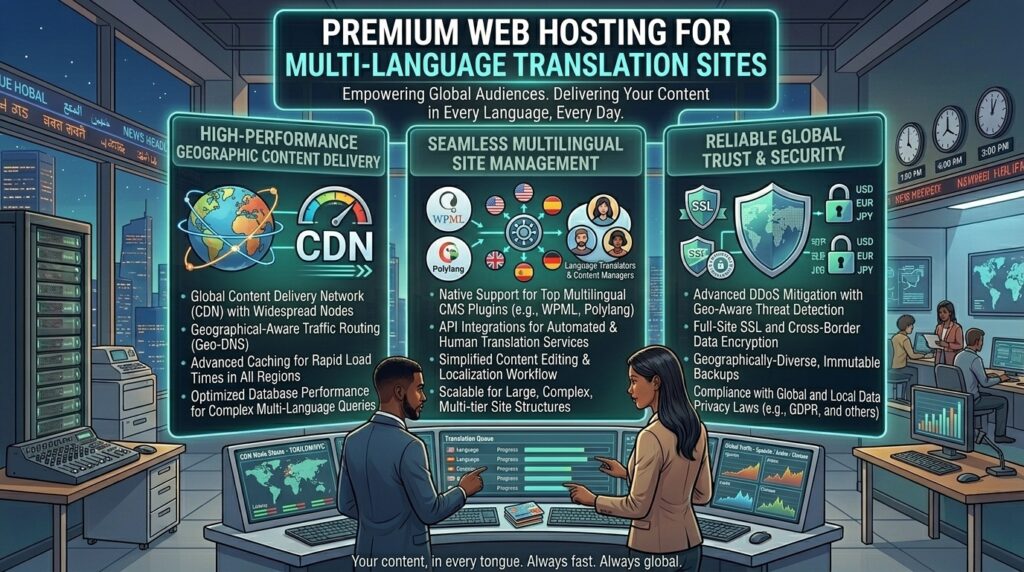
- Geographical Latency and Global Edge Delivery: If your server is physically hosted in a single data center in New York, a user visiting your Spanish or Japanese translation from Madrid or Tokyo will suffer from brutal physical network latency. Multi-language sites demand integrated global Content Delivery Networks (CDNs) to serve localized content from edge nodes closest to the user.
- Complex International SEO and Hreflang Indexing: Search engine crawlers (Googlebot) must crawl, parse, and index localized subdirectories or subdomains (
/es/,/ja/, orfr.yoursite.com) efficiently. Slow server response times (Time to First Byte – TTFB) can cause Google bots to abandon your pages mid-crawl, leaving your translated content unindexed.
2. Essential Technical Specifications to Demand
When shopping for web hosting to support a multi-language translation portal, look past standard marketing claims and demand these core technical parameters:
- High PHP Memory Allocation & Adjustable Limits: Ensure the host allows you to configure PHP memory limits up to 512MB and run modern PHP versions (PHP 8.2 or 8.3) for lightning-fast execution speeds.
- Server-Level Object Caching (Redis or Memcached): Essential for database-heavy translation platforms. Redis caches translated strings and database queries in server RAM, bypassing heavy SQL queries on subsequent page views.
- NVMe SSD Storage Infrastructure: Solid-state NVMe drives accelerate file read/write speeds by up to 10x, preventing lag when loading multi-locale media and localized script files.
- Global CDN and Anycast DNS Integration: Built-in integration with Cloudflare Enterprise or global edge networks to ensure your translated assets are cached and delivered instantly worldwide.
3. Top Web Hosting Providers Ranked for Multi-Language Translation Sites
Based on database management performance, PHP memory handling, global infrastructure reach, and SEO reliability, here are the top hosting options on the market:
A. Hostinger (Best Value and High-Speed Cloud Hosting for Growing Multi-Language Sites)
Hostinger combines aggressive pricing with high-performance infrastructure, making it a stellar option for budget-conscious international sites.
- Why it shines for Translation Sites: Hostinger utilizes high-speed LiteSpeed web servers paired with native LSCache capabilities, which handle dynamic translated pages remarkably well. Their cloud hosting tiers offer dedicated CPU and RAM allocations, ensuring your multi-locale databases never throttle under traffic surges.
- Best For: Small to mid-sized businesses launching bilingual or trilingual sites on a smart budget.
- Pricing: Cloud hosting plans start around $7.99 to $9.99/month.
B. SiteGround (Best Managed WordPress Host for Complex Translation Plugins)
Powered by the Google Cloud Platform, SiteGround is globally recognized for superior speed, bulletproof security, and advanced caching architecture optimized for heavy plugins like WPML.
- Why it shines for Translation Sites: SiteGround features a proprietary SuperCacher system, dynamic caching layers, and generous PHP memory configurations. Their servers absorb heavy database write actions generated by automated translation tools without breaking a sweat.
- Best For: Established publishers and WooCommerce multilingual shops running WordPress who want hands-off reliability.
- Pricing: Introductory plans start between $3.95 and $7.99/month.
C. ScalaHosting (Best Fully Managed Cloud VPS for Large Global Enterprise Portals)
For massive multi-language web portals featuring dozens of translations and millions of monthly global visitors, ScalaHosting provides powerful, fully managed cloud VPS solutions.
- Why it shines for Translation Sites: You receive dedicated, unshared cloud resources (RAM, CPU cores, NVMe storage). Their custom SPanel platform allows you to fine-tune PHP extensions, configure Redis object caching effortlessly, and scale your server configuration instantly.
- Best For: Enterprise multilingual media networks and international e-commerce ecosystems requiring custom server environments.
- Pricing: Managed cloud VPS plans start around $14.95 to $29.95/month.
D. Cloudways (Best Flexible Managed Cloud Hosting for Scalable Global Traffic)
Cloudways provides a streamlined management layer on top of top-tier cloud providers like DigitalOcean, AWS, and Google Cloud.
- Why it shines for Translation Sites: Cloudways utilizes an advanced “Lightning Stack” (NGINX, Varnish, Apache, and Redis) designed to rocket-fuel dynamic content delivery. It allows you to deploy servers in data centers located directly inside your target international markets (e.g., Frankfurt, Tokyo, São Paulo, London).
- Best For: Developer-driven projects and scaling international marketing teams needing multi-region cloud flexibility.
- Pricing: Plans start around $14.00/month.
4. Masterclass: Technical SEO and Localization Architecture
Choosing high-performance hosting is only half the battle. To ensure your multi-language translation site ranks prominently on Google across different countries and languages, you must implement flawless technical SEO architecture:
Choosing the Right URL Structure for International SEO
Google recommends three distinct URL structures for multilingual websites. Your hosting server and CMS must be configured to support them cleanly:
- ccTLDs (Country Code Top-Level Domains – e.g.,
yoursite.com.mxoryoursite.fr): Excellent for geographic targeting, but requires purchasing and managing multiple distinct domains. - Subdomains (e.g.,
es.yoursite.comorja.yoursite.com): Easy to set up on cloud hosts via DNS CNAME or A records, allowing independent server routing if needed. - Subdirectories / Subfolders (e.g.,
[yoursite.com/es/](https://yoursite.com/es/)or[yoursite.com/de/](https://yoursite.com/de/)): Most SEO Experts’ Choice. Subdirectories pool all domain authority into a single root domain, making it easier to build organic search equity. Ensure your host’s permalink and rewrite rules handle language routing without throwing 404 errors.
Implementing Flawless Hreflang Tags
To prevent Google from penalizing your site for duplicate content across translated pages, implement precise hreflang link attributes in your HTML headers (or let plugins like WPML/Polylang handle them automatically). This tells Google crawler bots: “This Spanish page is an exact geographic translation of this English page; serve the Spanish version to users searching in Spain or Mexico.”
Optimizing Core Web Vitals for International Audiences
Global users will experience varying connection speeds. To pass mobile Core Web Vitals worldwide:
- Leverage Redis object caching to keep your Time to First Byte (TTFB) below 200 milliseconds.
- Utilize a global CDN to cache translated static pages at edge nodes in Europe, Asia, and the Americas.
- Optimize localized fonts and translate images dynamically without bloating page weight.
5. Frequently Asked Questions (FAQ)
1. Does a multi-language translation plugin slow down my website?
Yes, translation plugins add database queries and computational overhead. However, the performance impact is minimized if your website is hosted on a high-performance platform equipped with NVMe storage and Redis object caching.
2. Should I use subdomains or subdirectories for my multi-language site SEO?
For most websites, subdirectories ([yoursite.com/es/](https://yoursite.com/es/)) are recommended by SEO experts because they consolidate all backlink authority into a single root domain, whereas subdomains are treated more independently by Google.
3. What PHP memory limit do I need for a multilingual WordPress site?
You should configure your web hosting PHP memory limit to at least 256MB (preferably 512MB) to prevent fatal error crashes during heavy batch translation syncs or database lookups.
4. Can I use cheap shared hosting for a multi-language website?
Cheap entry-level shared hosting is strongly discouraged for multilingual sites. Shared servers lack the CPU power and RAM required to handle complex database joins for multiple language versions, leading to slow load times and server timeouts.
5. Do I need multiple hosting accounts if my site is in five different languages?
No. You can host all languages on a single high-performance cloud server, VPS, or managed hosting account (like Hostinger Cloud or ScalaHosting) by utilizing clean subdirectories or subdomains.
6. How does a Content Delivery Network (CDN) help multilingual sites?
A CDN caches your translated static pages and media across hundreds of global edge data centers, ensuring that international visitors from Tokyo or Paris experience sub-second load times regardless of where your origin server is located.
7. Why is Google indexing my translated pages incorrectly?
Incorrect indexing usually stems from missing or misconfigured hreflang tags, or duplicate content issues caused by improper URL canonicalization. Verify your translation plugin’s SEO settings carefully.
8. How do I handle currency and regional pricing localization on my translated site?
If you run a multilingual e-commerce store (WooCommerce), use multi-currency plugins paired with a robust caching host (like SiteGround or Cloudways) that supports geolocation caching exceptions so users see correct local currencies instantly.
9. Will Google rank my translated pages as high as my original English pages?
Yes, provided your translations are high quality (preferably human-reviewed AI translations) and your site maintains strong E-E-A-T (Experience, Expertise, Authoritativeness, and Trustworthiness) signals within each target language market.
10. How can I test my multilingual site’s global speed and SEO performance?
You can benchmark your server response times, regional latency, and mobile Core Web Vitals performance across different global locations using testing tools like Google PageSpeed Insights, GTmetrix, and WebPageTest.org.
6. Conclusion
Expanding your digital footprint with a multi-language translation site is a powerful catalyst for global growth. However, trusting your international brand to sluggish, unoptimized web hosting will bottleneck your database, frustrate global users, and damage your Google search rankings.